“I don't know what to call this relationship, a little beyond friendship, but something closer to love… something like that.”
“My mother raised me alone and so strong that I didn't think I needed a man in my life. Before my parents separated,however, my father was seen beating the mother. All the men that came into my life after that were abusive, so casual relationships are fine, but I have absolutely no desire to break up. "Sometimes you realize that things have gotten so bad that, like a soft tomato that won't burst, the relationship can't go any further." It is best to leave it there.”
“I like many people at once. I'm polyamorous … and through some dating apps I've met not only great partners, but such great people as friends that sex becomes secondary. He has also brought me out of mental and physical ailments.” This and many other quotes. So many stories connected with them and a colorful world seen from it. By Prayas Arogya Group1240 This story is one of many things that came up while researching Youth in Transition by talking to young boys and girls.
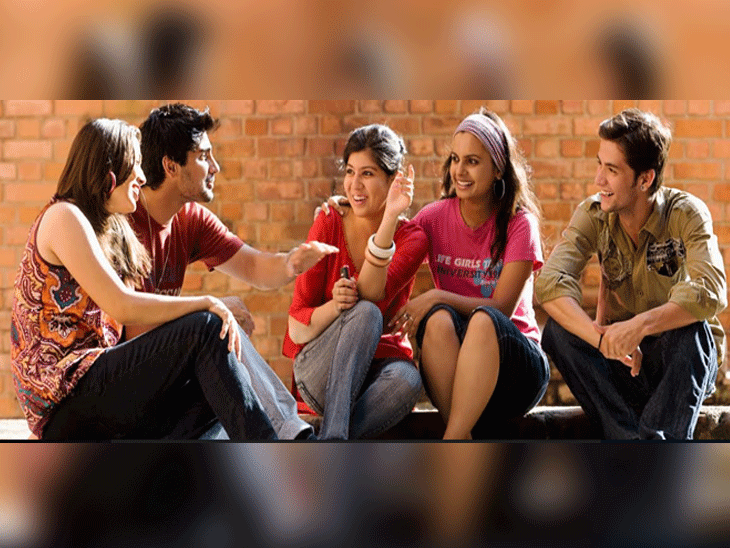
Given the right space and opportunity, young people talk a lot about relationships, and there are countless things that come up that are fresh, thought-provoking, and challenge, if any, opinions and prejudices. This change in the name of 'Youth in Transition' was as much about the events in their mind and body as it was about the social context, the world around them, their thoughts, feelings, expectations of life, their outlook towards life and the world around them.
Relationships stand out in this transition of age. Today's young people speak freely to us, who are making close, new relationships, preserving, cultivating, breaking, understanding them from different parts, examining them in the context of their own lives, analyzing them, weighing them in relation to the society around them and aligning themselves with the norms of the society. Despite having to talk about topics that are always kept in the bouquet, like relationships and sex. On the one hand, there is an amazing curiosity in society about this subject, but our opinions are also limited because they are built in our own circle. Our information may be based on hearsay and the sources of information are sometimes solid or crude. Therefore, when the time came to verify our lives in this context, we had to take a look at this subject.

Background of the research
'Attempt'The health group of the organization has been working in the field of health in Pune for the last twenty-five years. At the time of the Institute's inception, as it began to work on HIV and other sexually transmitted diseases, there was a growing awareness of the urgency of research and awareness of these issues, and a desire to further understand these topics, generate new perspectives, and provide a scholarly conceptual framework to complement our work. . Since then, such work has also started.
Youth in Transition is the most recent study of the Prayas Arogya Group. The aim was to understand changes in the lives, decisions, relationships and, alternatively, the sexuality of urban youth. In fact, the reason for doing this study was directly medical. Prayas Arogya Group's clinics offer treatment for HIV and other sexually transmitted diseases. In fact, when HIV was brought under control, other sexually transmitted diseases were also under control. Now that HIV is under control, these other diseases are starting to see a resurgence. It begs the question of what is the reason for this happening now?
Is there not enough and correct information about sexually transmitted diseases or is the information not connected to one's own life or something else? To find the answer to this question, it was necessary to understand the current context and the difference, and for this, Prayas Arogya Group also conducted a small qualitative study with various stakeholders. Again, this suggests that there is currently a lack of extensive research to understand the sexual life experiences of young, single people. Not only this, this 'unmarried' population has almost no sexual health needs. In fact, their sex lives are considered to be invisible. If there is to be any change in this seemingly indifferent health situation, it is felt that there is a need to study more deeply about the availability of information, the attitude of the youth towards health care and their decision-making ability. And with that the study began.
Although the rationale behind this study is medical, the topic of sexuality is not limited to venereal diseases. Sexuality is a pervasive aspect of life. Gender, sexuality, sexual orientation, gender identity, gender roles, libido, pleasure, intimacy, reproduction, thoughts, dreams, desires, perceptions, attitudes, values, behaviors, practices, relationships, good and bad experiences, as well as many dimensions of the unconscious and latent. come under the scope of sexuality.
Of course, these dimensions are also changing according to the changing context of a changing world. In the urban areas where we were going to study the lives of the youth, technology, communication tools, media, social media have all the information we need at our fingertips. It is no longer difficult to peek into someone else's life and present one's own life as desired, thus the nature of friendships and relationships have also changed. There are more ways to connect with each other than ever before, creating new ways of relating, giving them new names, not looking at them in traditional, stereotyped ways. Due to increasing urbanization, the age of marriage has also increased. There is also an increase in the number and possibility of choosing other options to remain single. Ignorance of many categories of gender identity, gender identity and sexual orientation is being eradicated.
We wanted to explore the many aspects of sexuality that are connected to every individual's life and not limited to healthcare delivery, but also to creating healthy language, communication and space around sexuality, to mental processes, to creating mechanisms that confront them, to education, to policy advocacy, to a path to a holistic approach. we realized this.

Research outline
Education, career, living space, relationships, various experiences in relationships, sexual behavior, mental health, addictions, experiences of sexual harassment, home environment and the information, attitudes and questions we have can all be related. Maybe it be mutually influencing. The events that happened before can lead to subsequent decisions, in the sense that various events in life are related to each other. In order to know the links and formulas in find it, the timeline of all the above events that happened in life from the age of ten to the present day is presented on a whole calendar with the help of the interviewer/participant. In this way, the whole picture of what happened at various levels in life can be seen together. In relationships, in love, our experiences shape our future experiences.
Many people told us that they realized many new things during the interview process. At what moment, at what time, what we felt, what we decided, has its roots in a complicated sequence of events. For the first time, people could talk about things that they had never talked about with anyone, they could freely ask their questions. Not only that, but most of them had fun reviewing their lives. The interviewers were sensitive and non-judgmental.
Almost all of us are looking for a place where we can express our life from the heart without any opinion-advice-suggestion. Many people said that they got it here. Many people asked their friends on social media and in person to participate in this research, and we were able to reach the numbers required for the analysis of the research. To reach people, we went to colleges and held group sessions, used social media, asked famous friends of our acquaintance to publicize it on their Facebook and Instagram accounts. We also asked friends of our acquaintance who fit the eligibility criteria to participate in the study. Many also gave us verbal and written feedback. The trust built through the interview process, the guarantee of safety and confidentiality, the personal benefit of the interview, and the help in participants' thought processes made this possible over nearly two years. We wondered if people would be willing to talk about sexuality. But beyond the experience of relationships or not, the topic was connected to every life, and they wanted to talk about it.
Many have suggested that sexual health is closely related to mental health. But apart from mental health, we often have sexual health and reproductive health being looked at today through different programmes. Programs on reproductive health are limited to maternal and child health. But there are almost no places for single young women to talk about sexual and reproductive health issues. They find it difficult to go to government hospitals with their questions and cannot afford the services of neutral counselors, gynecologists.
The questions that came out of this research led to the creation of the web series 'Safe Journeys' towards increasing the skills and abilities in oneself. The resulting eight short films are available on YouTube, reaching a wide audience and being received and consumed at various levels. What was seen in this broad framework, the issues and experiences that came to the fore will be presented in detail in the next article.