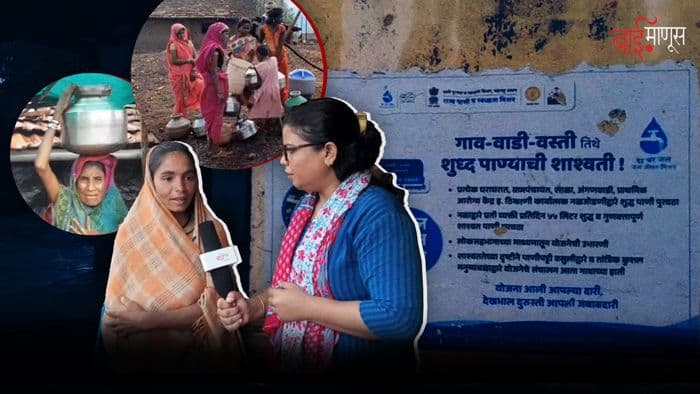
"Jal Jeevan Mission: What is it? I have never ever heard of such a plan. My door is not yet served by the tap. Our pada has a single hand pump that provides water to the women of the village and me. My house is two kilometers away from the hand pump. I always have two pots of water with me. I bring three batches in the morning and two at night, keeping it in mind."
Lila Vasave, who lives in Patilpada, at Nandurbar district's Akkalkuwa taluka, where 142 people reside, responded as follows. Her identity is included under the government's "Jal Jeevan Mission Yojana," a program that documents the existence of a tap in her home. Her ignorance of the specifics of the "Jal Jeevan Mission Yojana" is startling. She asks how it is recorded that there is a tap in her house after spending three to four hours a day trekking two kilometers to fill it.

An occurrence like this could be misinterpreted because there could have been technical errors, causing the government office to formally record that there is a tap in the house when in reality there isn't one! These kinds of instances, in addition to Lila Vasave's, are present in other padas in the Akkalkuwa taluka. By bringing such occurrences to light, BaiManus has attempted to demonstrate the inefficiency of the Jal Jeevan Mission initiative.

'Har Ghar Nal... Har Ghar Jal...' What is the scheme?
"Har Ghar Jal... Har Ghar Nal..." With considerable excitement, the government opened Jal Jeevan Mission Works throughout the state. The administration ran ads supporting the Jal Jeevan Mission even during the recent Lok Sabha election campaign.
The Central Government launched the 'Jal Jeevan Mission' program in 2021. Certain regions of the nation still lack access to safe drinking water. The government is attempting to solve this issue in a number of ways, so that every home can have access to clean drinking water. The 'Har Ghar Nal' (Tap for Every House) initiative was introduced by the central government in 2021.
By 2024, the program aims to improve the nation's health and supply clean water to rural areas. In addition, this program will raise the national average living standards for all citizens.

The program, which aims to supply drinkable water at a rate of 55 liters per person per day, was created so that people would not have to go far to get water. In order to fulfill this aim, the government threw a lavish opening ceremony for the Jal Jeevan Mission, which will operate in the isolated and tribal-dominated district of Nandurbar. Despite the fact that the Jal Jeevan Mission has been operating in the district for two years, its work in the rural areas is still unfinished.
The government claims that their houses have taps, but in reality...
The tribals of Nandurbar district are likely to avail tap and water under this scheme someday, for sure, but this is not the question! The shocking information that came out after 'BaiManus' visited different parts of Nandurbar and reviewed the Jal Jeevan Mission scheme of the government is surprising.
Since the outset, tribal residents of numerous villages in this district have been forced to make do with subpar facilities. 'Water' is the main issue for these folks. These people suffer greatly in the summer from a shortage of water. These indigenous people must forage for water every day for a whole year, and not just during the summer.
These tribes experienced some respite when the 'Jal Jeevan Mission' program of the central government was implemented. However, the 'Har Ghar Nal' initiative introduced by the 'Jal Jeevan Mission' remains unfulfilled as none of these government schemes have reached these tribal communities to far.
Information on Jal Jeevan Mission's official website shows that Urmilamal village in Akkalkuwa taluka of Nandurbar district has 165 houses. The work of bringing taps to 49 houses has been successfully completed, and the work of bringing taps to the remaining 116 houses is going on. But the reality is different.
Ganesh Bhanga Vasave lives in the village of Urmilamal. According to the Jal Jeevan Mission's official government website, Ganesh's home receives water through a tap. Ganesh Vasave states, "A water tank has been built and a well has been dug in our village under the 'Har Ghar Jal' mission," following 'BaiManus's visit to his home and direct interaction with him.
However, because the pipe-laying job was not finished, the pipe did not reach my residence. We still have to travel a kilometer to get water. Since there are animals in the house, they require this water. Therefore, my wife has go bring water three to four times a day."

If I had a tap in my house, why would I have filled water straight for four hours?
At Patilpada in Akkalkuwa taluka of Nandurbar district, there are 29 houses inhabited by 142 people. 21 dwellings have been connected, according to information on the Jal Jeevan Mission's official website. At Patilpada, Hanjya Punya Vasave resides.
According to the official website, he is one of the recipients and his house's pipeline work is finished. However, when Hanjya Punya Vasave's wife Leela Vasave was questioned about how this scheme is been operated, she responded, "I don't even know the name of this scheme. My door is not yet served by the tap.
The women of the village and I get water from a hand pump on our pada. My house is two kilometers away from the hand pump. I fetch water by wearing two pots at once atop my head. I deliver two batches of water at night and three batches in the morning."
The Jal Jeevan Mission is one of the 572 initiatives for which 198 crore has been spent. 446 schemes are still awaiting work. Elections were held, and a government was established, but as is the case each year, neither a political party nor an administration is giving tribal matters any thought.

There are ten padas in Nandalwad village in the same taluka as Akkalkuwa. In those padas live 1533 indigenous people. The official website of 'Jal Jeevan Mission' states that there are 367 dwellings in these padas, of which 25 have taps installed and 342 are in the process of having taps installed. The 'Jal Jeevan Mission' scheme is unknown to Arkibai, who lives in the same village of Nandalwad.
"I fill water from my relative's private borewell," claims Arkibai. She must go a considerable distance to retrieve water if it is not there. There is a hand pump close to her home, but it doesn't produce any water because the pipe is too short.
This problem is not of Arkibai alone but of every women in the village. They need to get water for livestock and housework in addition to drinking. Ramila, a resident of Nandalwad village says that she fills water for two to three hours every day. This is what she must do eight to ten times a day. On days when there is labor in the field, Ramila finds it extremely difficult to fill the water.

Why does the government's website lie?
There are 795 people living in Khardi (Khurd) village in the Nandurbar district's Akarani (Dhadgaon) taluka. There are 206 households in the village, according to the Jal Jeevan Mission's official website. Of them, 198 have had their taps connected, while the remaining eight are now undergoing the process. However, the names of only 23 people are listed on the same official website, and no information regarding which of the remaining 175 residences has been contacted is provided..
The 'Har Ghar Nal' program made its way to that community when BaiManus paid a visit. However, it was noted that the project was dropped after just half of it was completed.

Persuaded that he would not benefit from the government plan, Gulab Chand Pawara, a farmer from Khardi village, saved up all the money needed to dig a private borewell on his land. In order to replenish the same borewell, the residents of the nearby pada likewise band together.
According to Gulabchand Pawara, "Women fill water from my borewell all day long. However, my borewell empties in the summer, so these women must fetch water from a different village."
People now have a hope, thanks to the Jal Jeevan Mission, that every household in the nation would have access to safe drinking water, improving everyone's health and standard of living.
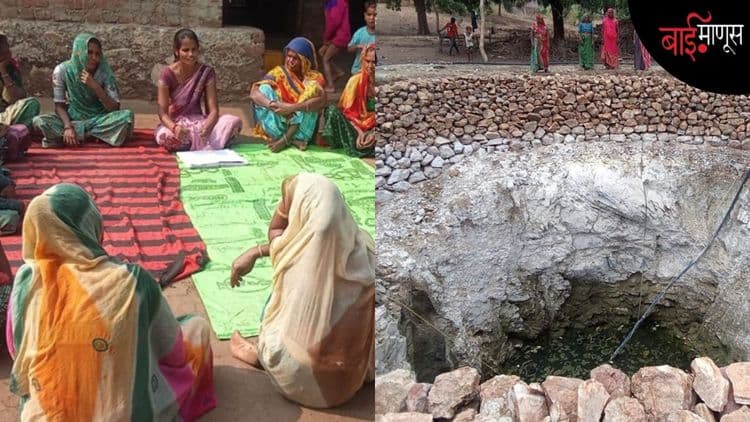
A pada has only one or two wells. They dry up in the summer.
In the summer, the ladies in the pada do not even obtain water from the hand pumps or wells. Currently, the ladies of Khardi village still dedicate two to three hours every day to gather water. Their health issues have consequently surfaced.

"To get water, we visit another pada. It is necessary to fetch at least four to five batches of water. The head and knees ached after hauling pots over such a distance." According to Sevibai, a resident of Khardi village, "the water pots are very heavy."
"Under the Jal Jeevan Mission Yojana, a well has been dug in only one pada in the village, and there is no tank; no pipe has been laid anywhere," declares Madhav Pawara, Sarpanch of Rajbardi Group Gram Panchayat in Akrani Taluka of Nandurbar District. The identity of the contractor assigned this task is unknown to us."
The group development authorities responded ambiguously when BaiManus questioned them about why the "Har Ghar Jal" scheme's work is moving so slowly. The water supply department's office was closed. There, Gram Sevak stated that we don't get any letters.
When they wish to, they start and stop working. For the past four months, there has been a serious water deficit in rural Maharashtra. The pledges and catchphrases used during the Lok Sabha elections were never heard again. Elections for the Vidhan Sabha will soon take place. It is still unclear if the political figures that knock on doors to get votes will provide water to these homes.