During the conservation work of Pandharpur 's Vitthal temple, some idols were found in a cellar and after this whole incident, many kinds of claims and counter-claims have started. What is the historical significance of finding this new idol? Whether it has anything to do with the Varkari tradition, as well as the veracity of the claims made regarding the exposed basement, is currently the subject of a large-scale debate in Maharashtra.
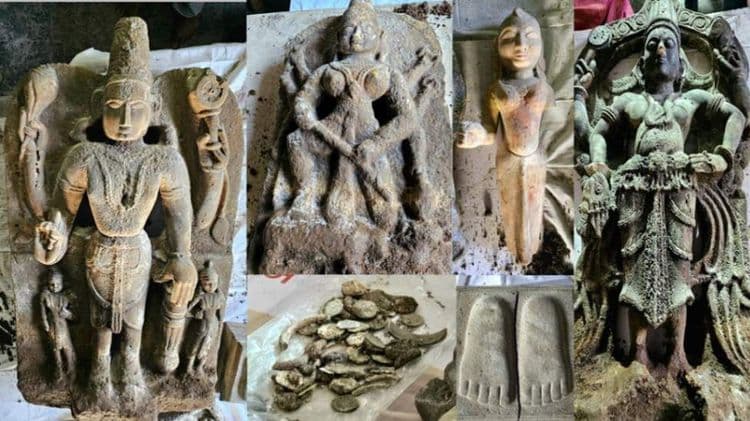
While the preservation and conservation work of Shree Vitthal Rukmini Mandir was going on, the staff of the Antiquities Department discovered the basement of the Vitthal Mandir on Friday (31st). Three stone idols and padukas have been found in this basement. The work of the Department of Archeology is still going on here. Executive Officer of Temple Committee Rajendra Shelke and Manager Balaji Pudalwad have given the information about the discovery of tunnels in a press conference. The archeology department staff was working near the Hanuman Darwaja in the Solkhambi area of the temple.
At that time a stone was moved and it was found that there was a cavity under it. After removing the stone, it was found that there was a large cellar at that place. After inspection by temple committee officer and archeology department architect Tejaswini Afhale, it was found that the basement is five to ten feet. Stairs to the basement were found. At present it is dark in the basement and there is a possibility that there are some idols etc. The basement was inspected after the expert and co-chairman of the temple committee Gahininath Maharaj Ausekar reached Pandharpur. When the soil in the basement was excavated, three stone idols, padukas and some coins are said to have been found there. Soil is still being pumped out of this basement.

The idol was moved for protection
Around 5300 years ago, Sant Prahlad Maharaj Badve and Patil Suryajirao Ghadge of Degaon tried to prevent Vitthal Murthy from being attacked by invaders. The idol of Vitthal was moved from the Vitthal temple in 1665 and during Aurangzeb's invasion between 2 October 1695 and 13 October 1699 to save the idol of Vitthal during the raids of Afjalkhana who were destroying temples.
The idol was hidden in a well in the farm of Suryajirao Ghadge Patil of Degaon near Pandharpur. If the water is drawn up, the idol will be seen, so Ghadge Patil saved the idol without giving the water from the well to agriculture. For about six years continued the daily treatment of God. The idol was kept hidden in a haystack for a few days. Also, Suryaji Ghadge also hid the Vitthal idol in the basement of his palace for a few months.
After the crisis was over, the Vitthal idol was again brought to the Pandharpur temple. In commemoration of this incident, Idol Conservation Day is still observed on Shravan Shuddha Panchamila at Degaon by Warkari Sampradaya, Badve Samaj and Patil family. Various religious programs are held on this occasion. There is also evidence of moving the idol of Vitthala in Pandharpur in Chincholi, Gulsare etc villages near Pandharpur.
Idol Debate
The present idol is not the original idol in the Middle Ages. Claims were made that the original idol had been shifted elsewhere. The symptoms on the body of the idol mentioned in the Puranic texts are found on the idol of Srivitthala at Madha. Therefore, it is possible that the idol of Vitthala, which was moved from Pandharpur to Madhya from the invaders, was not brought back, senior researcher Res. Ch. Dhere expressed. He has presented his research on Vitthal Murthy in his book ' Srivitthal: Ek Mahasamanvay'.
However, the current idol in Pandharpur is the original idol of Vitthala, said Dr. Sadanand More refuted Dhere's claim. So the history researcher c. h. Practitioner of Khare and Murtishastra Go. b. Deglaurkar has also confirmed that the current idol is the original idol.

Idol 15th to 16th century?
Vilas Vahane, assistant director of the Archeology Department's Pune division, while talking to the BBC, suggested that the idols could be dated between the 15th and 16th centuries. From the weapons in the idol and the shape of the face, it can be guessed from which era it belongs to. Generally the 17th or 18th century Maratha-Peshwa period idols are of a different style. Also, the idols of the Yadava period before the 15th century are different. He said that the idols found in the basement are different from the idols of both these periods, so the idols may belong to the 15th to 16th century, but nothing can be said for sure, he said.
“Two of these idols in the form of Vishnu are very beautiful. These idols may be in the temple area itself. Because on the 16-pillared mandapa, there are Vaishnava gatekeepers with weapons on either side of the idol of Vishnu. These idols are of the same form,” Vahane said.
He also said that many inscriptions about the temple are available, and he will try to guess about it after reading them.
When the idols were found in the basement, a lot of soil was also removed. Coins like one rupee, 25 paise, and 5 paise have been found in that soil. Bangles and pieces of plastic have also been found. The coins found may date back to the mid-1980s. Therefore, Vahane has also speculated that these idols must have been placed here around 1981-82. In old or breached moors the method of release is seen to have started later. He also said that before that the idols could have been kept here without throwing them away.
It has not yet been decided whether the idols and other things found in the basement of the temple will be kept by the temple committee or handed over to the archeology department. The temple committee will take a decision on this.