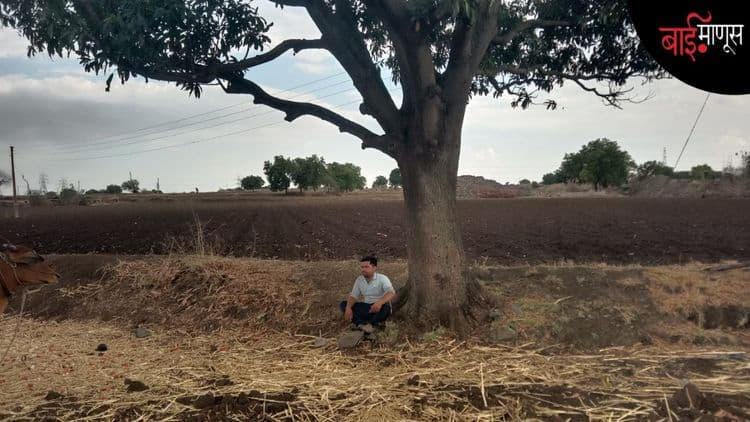
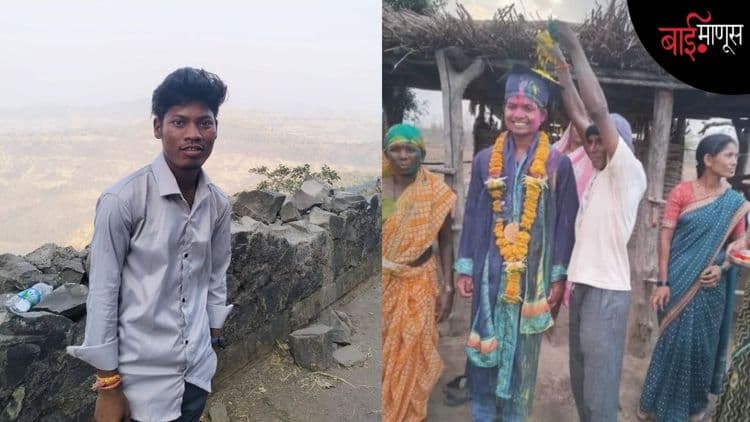
A little girl of four or five years of age, who had no idea of his struggle for survival, was playing on his back with her arms around his neck. Just this morning, Shalik and ten-twelve people from his village had entered Navi Mumbai by Vidarbha Express carrying their families . They made their own structures out of sticks and sheets on a pile of debris next to Seawoods railway station. The women who came with them were in the process of presenting the teaching material brought from their heads.
Shalik and a few others were sitting in the shade on the footpath next to the road, spending the night's journey. Some time ago, they went to Nerul Naksha for employment and came back because they did not get employment... Each of them has a small amount of dry land in their village.

"If the rains recover, the cotton and soybean crops are harvested. Prabhakar Shinde, sitting nearby, said that during the rest of the time, he does farm labor in the village. This year, the leaves of the leaves are in poor condition. Pulling Prabhakar's ri, Kerba, who was lying beside him with a sheet under his stomach, began to tell. Seeing the wrinkled face, white hair, and stubble of beard, he asked, 'How old are you?' So they said, Seventy two less... then even at this age they left the village for work, Kerba laughed at this question and said, Mang kaya Karav Sayeb... Zinda rahale alo, ya Porahi Sangam... They stopped talking like this. But knowing what to say next, he looked at me for a long time and smiled slowly... but he couldn't hide the pain behind that old smiling face...
The lives of these people who have died due to lack of water are reaching the cities...
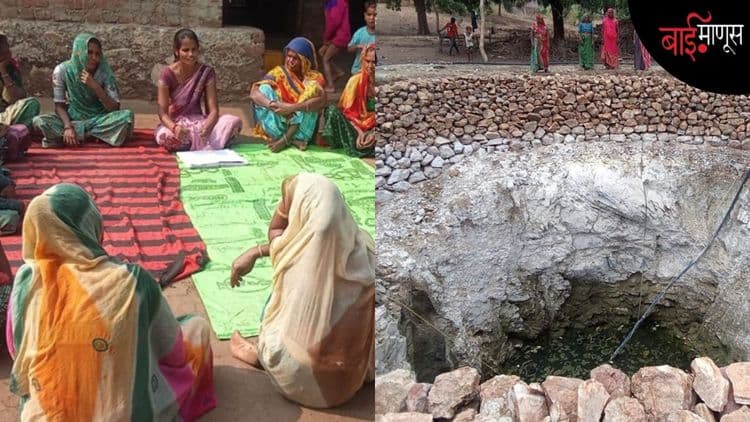
Drought in the rural areas and unseasonal rains in the middle have affected everyone. There is no work because there is no water, there is no money because there is no work, there is no food for the stomach because there is no money. People just got carried away. Their patience is running out. Still, with the sole aim of surviving, these souls, who have become destitute due to lack of water, are coming to the cities.
Under the Sanpada Bridge in Navi Mumbai, on the footpath outside the Agriculture Produce Market Committee in Vashi, on the Ukirda next to the Seawoods Railway Station, under the bridge in the main square of Kalamboli, people come from Marathwada, Vidarbha, and wherever they can. The main reason for choosing these places is that they are close to these places where there are workers in the area. In the morning, these knowledgeable people go to seek employment as nose workers.
Some get work, some don't. Then those who don't get work come back to us again. The rest of the next day is spent lying down starving. This unskilled working class without any art. So, some work under the hands of a mason, and some work as a daily wage with a lawsuit. But even here, their bad luck is not over.

Raju Rumale, who had come fifteen days ago with his brother and sister-in-law under the bridge of Sanpada, was sitting in a deep state of thought with both his hands on his knees and a scarf around his neck. Hailing from Ooty village in Mahagao taluk of Yavatmal district, Raju had been working with a suit for eight days to lay slabs for the building. He worked continuously for five days for 300 rupees a day.
Shetle asked for money, and he said he would give it, what else did he give the barber... I asked him what to do now. So he said, I paid money to the barber and went to his place as a barber for three days. Yesterday I found work at another place... Now Sanjila is paying money... 1500 rupees for five days was a lot of money for Raju who came from a drought-affected area. But his lawsuit had troubled him for money, wondering where this boy from a drought-stricken area was going. Maybe with that money, he wants to feed his three-year-old nephew, buy her a toy, maybe buy something for himself. But none of this will happen without money.
'Come and live at our place, so 'this' recovery'
Another example of how we urban people take advantage of the situation of the drought victims came out from the speech of Manik who came from Nanded. Manik has been coming to Navi Mumbai for employment for the past four to five years. Adjacent to Seawoods station is a village called Darave. A gang of youths from this village forcefully extort Rs 100 a month each from these drought-prone people in exchange for living here. Why do you say, come and stay at our place, that's why this recovery.
Why do we pay to argue? On the other hand, Kut Janar. If you ask to get a room for rent, they ask for a deposit of ten thousand rupees. Now, if Saeb had so much money, would he have stayed in the village? Manik's question was straightforward. The people with him also nodded their heads and confirmed his statement. Apart from this, are there any other problems, thefts, etc.? Manik shook his head saying "No" to my question, Sayab, what do we have to steal...

Maruti Garje, who is only 15-17 years old, runs a wooden wheel to extract sugarcane juice in the village of Karave, Navi Mumbai. This aunt-nephew duo earns Rs 400-500 a day by pushing and pushing the wooden stick of the charaka with their aunt. Manekdindi village of Pathardi in Ahmednagar district has been affected by drought. So these days, four people namely Maruti Garje, his cousin, and his uncle-aunt, who is studying in college, reach Navi Mumbai with a wooden charak.
Here a small space is rented for two months at the rate of 3000 rupees per month and four people extract sugarcane juice for their livelihood. Collecting money, this community conducts its life in these days, and goes back to the village as soon as the rainy season starts. When I asked how much a man make this wooden charak to push in the age of motor-driven charaka, aunt said, it cost 30 thousand rupees brother... it took two years... we used to extract a quintal of sugarcane juice a day... a quintal of sugarcane here costs 550 rupees... in the village we get 200- A quintal of sugarcane is supplied to the factory at Rs 250.
Two and a half hundred families from Marathwada have also camped in Dattaji Salvi Maidan in Bhatwadi, Ghatkopar area of Mumbai ... Their condition is said to be a little better than that of the drought-stricken migrants in Navi Mumbai. Because activists of some political parties come here and distribute free grains and pulses to them. Some youths from the colleges of Mumbai come and give biscuits to the children here. The local corporators have kept two big water tanks for them. It is filled with water twice a day by tankers. When I reached, a water tanker had just arrived there. Because of this, the husband and wife were rushing for water.
Who are the migrants from the drought-affected areas and who are the local poor?
Seeing that I was observing for a long time, one of them came forward. Balaji Rathod, who hails from the Mukhed area of Nanded, started reciting his complaint in front of me after telling me that he was a journalist. 'We came to Saib village saying there was no water, the Hitli people helped the mother... they gave grain, the Hitli people from the upper part of the village carried the grain for us...' As he was telling me something, some women came forward and started telling me.
From his speech, it was noticed that some charitable organizations from all over Mumbai, activists of various political parties, as well as people who want to help voluntarily come here and give food to these migrants to help the drought victims. Such people started distributing food grains and the poor people living in the slums in the surrounding area also came to buy this food grain. Not knowing who are the migrants from the drought-affected areas and who are the slum dwellers in the area, the people who came to distribute food simply gave food to everyone.
Their complaint was that they got less grain in their share. Of course, it was obvious that there must have been disputes between the migrants and the slum dwellers. But as there was no solution to this question, everyone came to Metakuti. Their struggle for survival was not over even after coming hundreds of kilometers away due to drought. Rather, he stood before them in a different, more intense form.
One thing was strongly felt in all these wanderings. That is, none of these people who have come so far to live alone, suffering the effects of drought and poverty, want to stay in the city forever. The luxury of the city may attract them, But they are aware that their family roots are still firmly rooted in those remote drought-stricken areas. Along with that, they also know that staying in the city permanently is not the answer to their problems. They want an answer to the ongoing drought, but in their own soil...

Vulnerability of drought-affected students
This drought has made people very helpless. Everyone is trying their best to get out of this vicious cycle. Then no one thinks whether that solution is good or bad. In fact, in the face of this crisis, there is no choice but to think like that. In the meantime, one of my friends told me that some young men were found begging in front of the Little World Mall of Kharghar sometime around eight-fifteen days ago.
A friend of mine who works for a news channel got suspicious as these young men did not look like beggars. When he inquired of these youths, he too was shocked. These youths were students of class 10-12. As there is no water in the village, they came here with their families to feed themselves. He tried to work as a daily wage earner with the elders of his family, but no one would take him to work, thinking that these young men would not do manual labor. Now what to do sitting down, so they started begging in this area.