Kripa Surana
India is facing a silent cancer epidemic. Breast cancer, which develops in the ducts or lobules of breast tissue. It is rapidly becoming one of the most common diseases. It is rapidly becoming one of the most common diseases in Indian women. India is facing a silent cancer epidemic. In 2023 alone, more than 2.03 lakh women were diagnosed with breast cancer, nearly a fivefold increase since 1990. The disease now claims over one lakh lives every year, making it one of the leading causes of cancer-related deaths among women in the country.
According to the National Library of Medicine, India has shown a drastic change in breast cancer over the past three decades. In 1990, there were around 35,000 new breast cancer cases annually, and the mortality rate was approximately 22,000. But by 2023, this number rose to 2.03 lakh cases and 1.02 lakh deaths. Another important indicator is the age-standardized incidence rate (ASIR), which measures the risk of developing breast cancer independent of population growth or aging. This rate increased from 13 cases per 100,000 women in 1990 to 29.4 per 100,000 women in 2023, reflecting a 126 percent increase in underlying risk.
Similarly, the age-standardized mortality rate (ASMR) rose from 8.9 deaths per 100,000 women to 15.5 per 100,000 women, indicating that the disease burden is increasing across different age groups in the country.
What are the reasons for the rise of breast cancer in India?
In India, nearly one out of every three female cancer cases in metropolitan cities is breast cancer. This trend is largely linked to lifestyle factors such as lower physical activity and higher rates of obesity. Apart from lifestyle patterns, reproductive and hormonal factors also play a role.
For instance, early menarche and late menopause increase lifetime exposure to estrogen, which is associated with a higher risk of breast cancer. Studies have shown that the risk of hormone-sensitive breast cancer is significantly higher for women whose first full-term pregnancy occurs after the age of 30.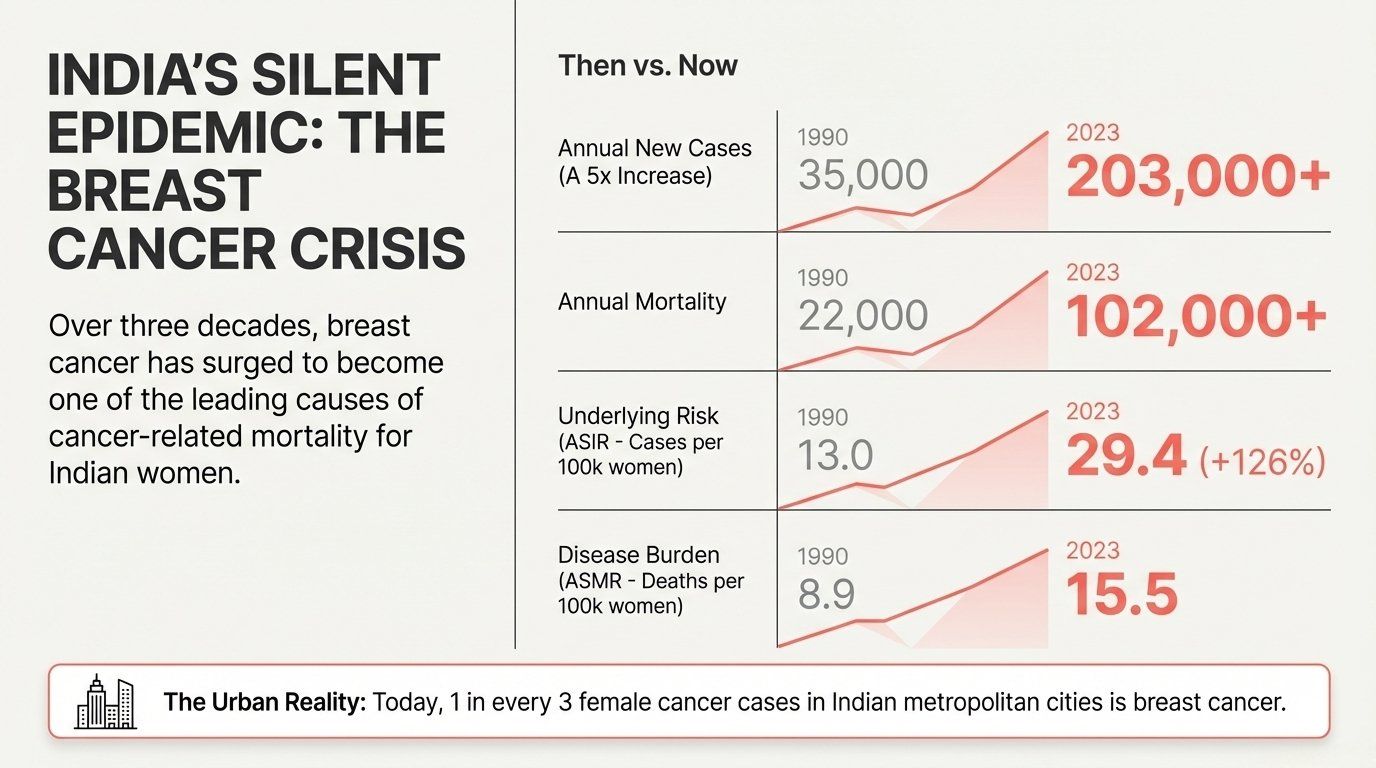 Inforgraphics (AI generated)
Moreover, nulliparity (not having children) and lower overall parity (having fewer children) have been identified as measurable risk factors. These shifts lead to a higher number of ovulatory cycles and prolonged exposure to endogenous hormones such as estrogen, which can stimulate abnormal cell growth in breast tissue. Shorter durations of breastfeeding, often linked to demanding work schedules and modern lifestyles, may also increase the risk. Breastfeeding delays the return of ovulation and helps in the terminal differentiation of breast cells, providing a protective effect. Research shows that every 12 months of breastfeeding is associated with a modest but cumulative reduction in breast cancer risk.
Certain communities and regions also show higher incidence rates. For instance, the Parsi community in Mumbai reports relatively high breast cancer rates, which researchers attribute to genetic factors, urban lifestyle patterns, and an older population structure.
Geographically, states such as Tamil Nadu, Telangana, Karnataka, and Delhi report higher incidence rates compared to many other regions of India. Experts link this pattern to greater urbanization, lifestyle changes, delayed childbirth, and better diagnostic infrastructure, which allows more cases to be detected and reported.
Late diagnosis remains one of the primary reasons for the high mortality rate of breast cancer in India. In high-income countries, 80%-85% of cases are diagnosed at stage I, whereas in India, approximately 57%-60% are diagnosed at an advanced stage (III or IV). Delays are usually caused by low awareness, cultural stigma, and limited screening practices.
What Study Indicates?
Studies show that although many women have heard about breast cancer, their understanding of early symptoms is limited. Dr. Rakshita Singh, on her Instagram reel, highlights several symptoms women should not ignore.“Women should pay attention to warning signs such as nipple inversion, persistent rashes or redness, unusual warmth, skin dimpling similar to the texture of an orange peel, nipple discharge, sudden changes in breast size, or the presence of a lump. These signs should never be ignored.”
A study in Aurangabad found that while 78.57% of women knew at least one symptom, only 37.86% recognized a painless lump as an early warning sign, leading many to ignore symptoms until the disease became more advanced. Cultural factors also play an important role, as modesty and stigma surrounding breast health discourage women from performing breast self-examinations or seeking clinical checkups. In addition, fear of diagnosis and its possible consequences, such as mastectomy and its impact on body image and marital relationships, often delays medical consultation. As a result, screening remains extremely low in India, with only about 1.6% of women aged 30–69 having undergone any form of breast cancer screening.
She also stresses the importance of regular self-examinations as a simple method for early detection,
Every woman should develop the habit of performing a breast self-examination every month after her menstrual cycle. Stand in front of a mirror, observe any visible changes, and gently palpate the breast and underarm area using your fingers to check for unusual lumps or tightness.
Moreover, she continued,
Even if you notice a change, there is no need to panic. Most findings are harmless, and if detected early, breast cancer can be treated effectively.
A Unique Indian Problem: Younger Women Are Getting Cancer
Beyond the sharp rise in cases, researchers have identified another worrying trend: breast cancer in India is increasingly affecting younger women. Unlike in Western countries, where breast cancer is usually detected after menopause, in India, it is often diagnosed during the premenopausal phase. One reason for this early onset is genetic mutations, particularly in the BRCA1 and BRCA2 genes, which are strongly linked to early-onset breast cancer.
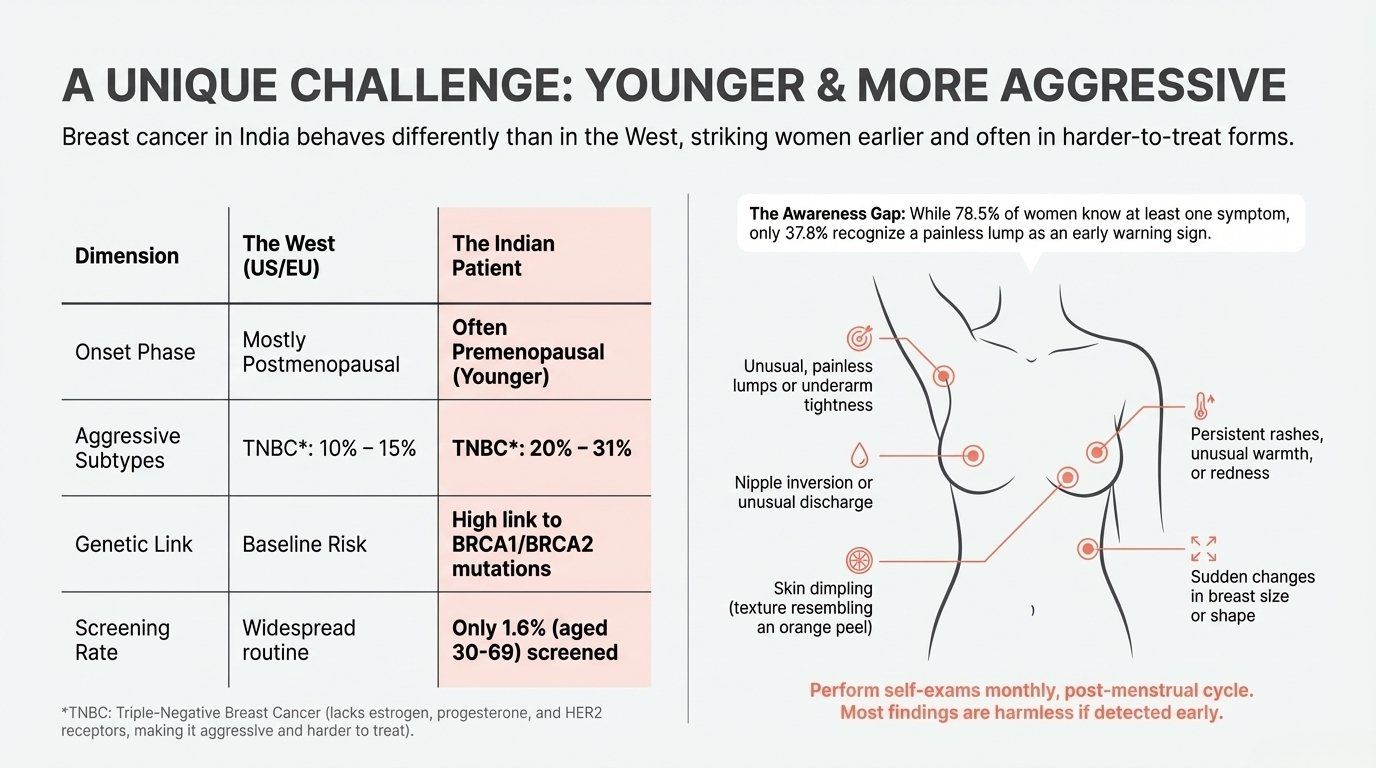 Inforgraphics (AI generated)
Another major factor is the higher prevalence of aggressive cancer subtypes such as Triple-Negative Breast Cancer (TNBC). This subtype is characterized by the absence of estrogen receptors (ER), progesterone receptors (PR), and HER2 expression. While TNBC accounts for roughly 10% to 15% of cases in the United States and Europe, it represents between 20% and 31% of cases in the Indian population.
What should be the treatment and management?
Breast cancer treatment depends largely on the stage at which the disease is detected. Doctors commonly use a combination of treatments such as surgery, chemotherapy, radiation therapy, hormone therapy, and targeted therapy to control or eliminate cancer cells. In many cases, surgery is performed to remove the tumour, which may involve removing only the cancerous tissue or, in advanced cases, the entire breast through a procedure known as mastectomy.
Chemotherapy and radiation therapy are often used to destroy remaining cancer cells and reduce the risk of recurrence. Hormone therapy is commonly recommended for cancers that are sensitive to hormones such as estrogen or progesterone. Experts emphasize that when breast cancer is detected at an early stage, the chances of successful treatment and survival increase significantly, highlighting the importance of early diagnosis and regular screening.
What actions are the Government taking?
Recognizing the growing burden of breast cancer, the Government of India has introduced several initiatives to improve treatment access and affordability. In response, the government has launched the Ayushman Bharat Pradhan Mantri Jan Arogya Yojana (AB-PMJAY) in 2018, which provides ₹5 lakh per year in health insurance coverage for secondary and tertiary care to the bottom 40% of the population. The Union Budget 2025–26 has also introduced measures to strengthen cancer care infrastructure.
The government plans to establish Day Care Cancer Centres (DCCCs) across district hospitals, with more than 200 centres approved for development across the country, enabling patients to receive chemotherapy and supportive care closer to home. To reduce the financial burden of treatment, 36 lifesaving cancer medicines have been fully exempted from Basic Customs Duty (BCD), while several others are available at a concessional duty of 5%.  Government Intervention: The Ayushman Bharat PM-JAY scheme provides vital health insurance coverage of ₹5 lakh per year for cancer treatment.
In addition, the government has established 19 State Cancer Institutes aimed at providing advanced surgical and radiation treatment facilities across different states. At the same time, India is investing in indigenous research and innovation to combat the disease. Initiatives such as the National Cancer Grid (NCG) and the development of advanced therapies like NexCAR19, a CAR-T cell therapy, highlight the country’s growing role in cutting-edge oncology research.
The rising burden of breast cancer presents a serious public health challenge for India. While improvements in treatment infrastructure and policy support are important steps forward, experts emphasize that early detection, greater awareness, and widespread screening will be crucial in reducing mortality. Without stronger preventive strategies, the number of cases is expected to continue rising in the coming decades, placing increasing pressure on families, healthcare systems, and the national economy.