Sanjana Khandare
- Palghar district is Smouldering… With projects like the bullet train, expressway, Vadhvan Port, Murbe Port, and now the vision of a ‘Fourth Mumbai,’ development is accelerating but it is also bringing several fundamental questions with it. BaiManus has started a special series to take a closer look at this issue.
- The Maharashtra Maritime Board has given permission to build a new all weather commercial port in the rocky coastal area near Murbe, close to Satpati.
- Locals say the proposed port could have a serious impact on fishing, livelihoods, and the marine environment.
- Without a transparent study, meaningful public consultation, and clear accountability, this project should not move forward. This is why local villagers have come out in protest against the Murbe Port.
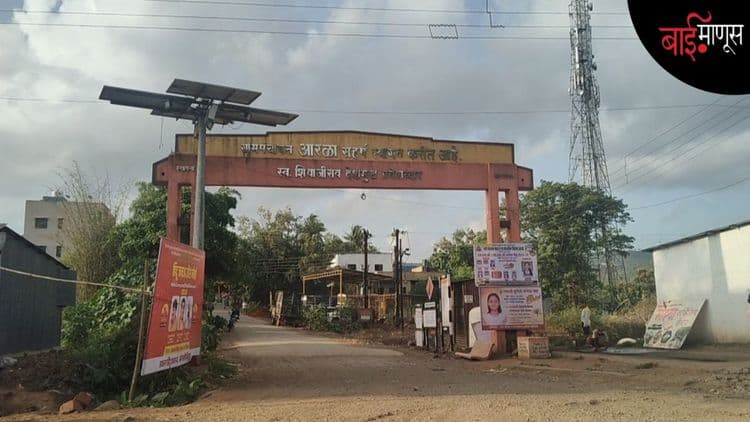
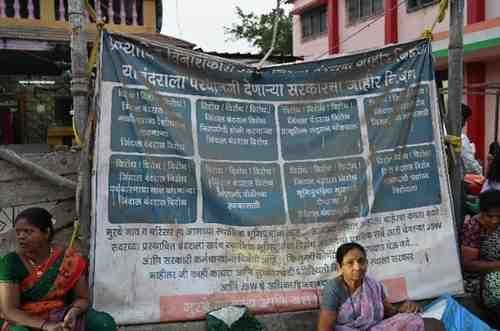
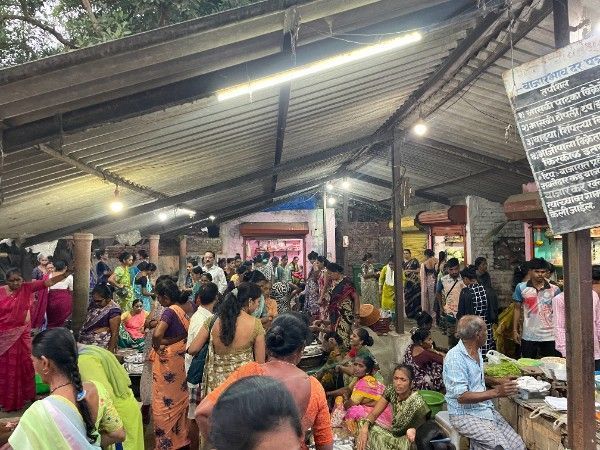
It was around 6 in the evening. As we entered Murbe village in Palghar district, there was a sense of activity all around. It was the village’s weekly market day. On one side, there were fish selling stalls, vegetables, groceries, and clothes. Most of the transactions in the market were being handled by women. It felt like a usual village market. But in the middle of that crowd, a large banner on the other side caught the eye. One resolve, “Cancel Murbe Port!”
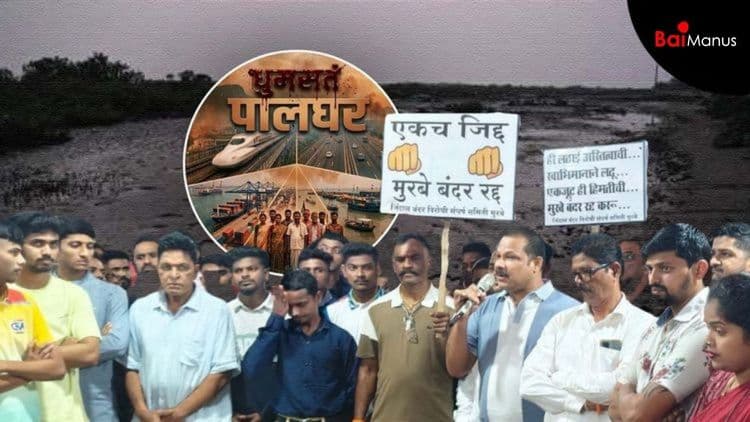
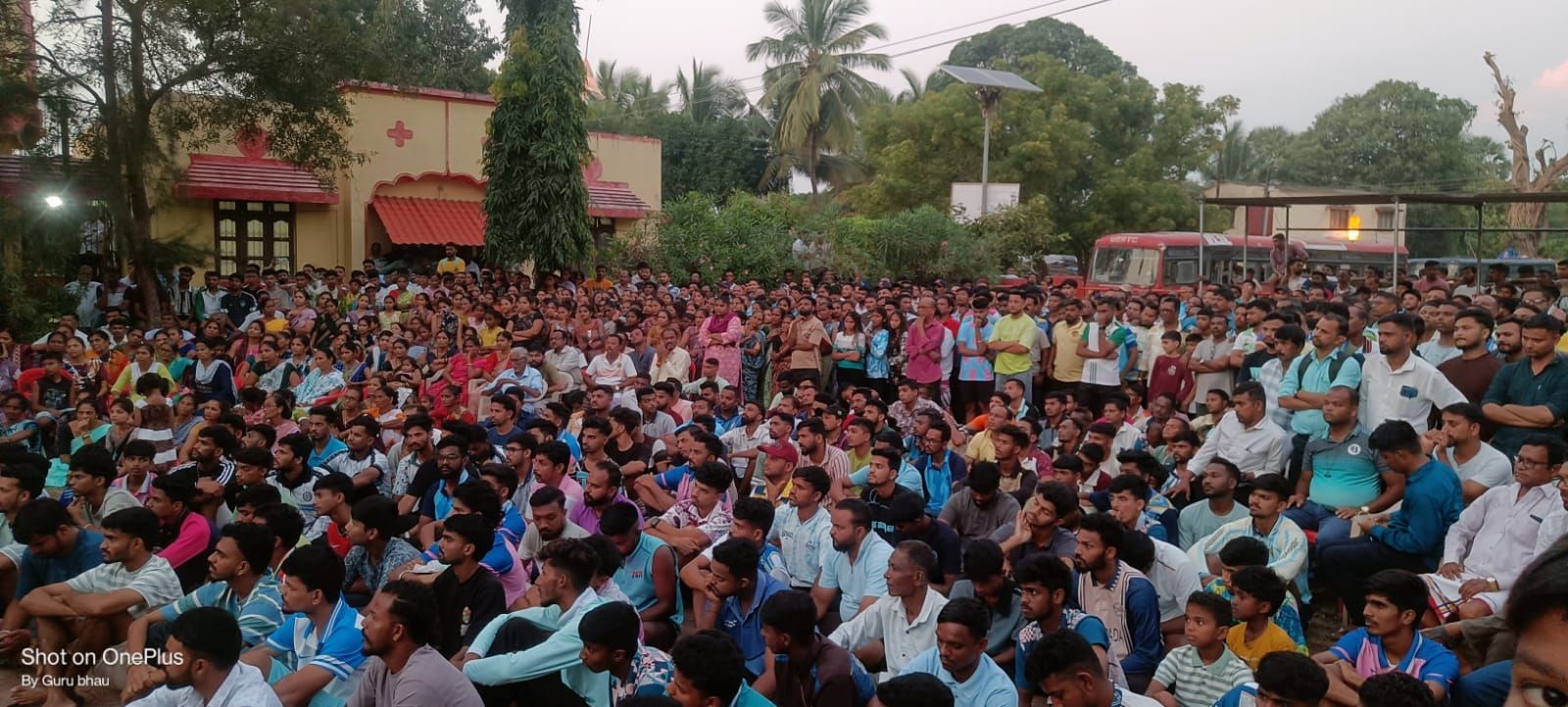
As we moved towards the proposed port site along the Murbe coast, the seriousness of the situation became clear within minutes. The moment villagers noticed an outside vehicle and a camera, nearly 200 people gathered within just five minutes. Many left their work midway and rushed towards the shore. Even the Sarpanch reached the spot immediately.
“Where have you come from?” “Why are you here?” “Why are you carrying a camera ?” “What kind of survey are you going to do?” Questions started pouring in from the crowd.
When we said we were journalists, the situation became even more tense. “Are you really going to show our side?” “You journalists are all sold out. You collect information from us, but only show what you want,” some villagers said angrily.
This wasn’t just questioning, it was fear, and a deep concern about the future. A fear of what lies ahead if a port comes up in Murbe. What will happen to our fishing? What will happen to our homes? What will happen to our children’s future? But the villagers are clear in their stand. “We will not allow even a single brick of this port to be laid in our village.” Looking at the ongoing struggle in Vadhvan, people in Murbe have already made up their minds. If this project is forced on them, it will face strong resistance. This feeling was visible among every villager.
Sarpanch of Murbe Gram Panchayat, Monalisa Swapnil More, alleges,
Port projects in Palghar taluka are being imposed without the consent of local people. The current expansion of ports is being forced on villages, and now a private port project is being brought to Murbe. The Gram Panchayat received a letter around three months ago, and only then did villagers come to know that the project earlier proposed in Nandgaon has now been shifted to Murbe. No detailed information was shared with the villagers, and no formal consent was taken. As soon as we came to know about the project, we all started opposing it.
According to the Sarpanch, the public hearing held on November 6, 2025, was seen by locals as “forced.” To oppose it, villagers formed a committee, sent letters from the Collector’s office to the Chief Minister’s office, and submitted thousands of objections. By their estimate, at least 50,000- 60,000 objections were filed, with some claiming the number could be as high as one lakh. However, a detailed report of these objections has still not been shared with the villagers. According to Sarpanch Monalisa More, there is an attempt to push the project forward without the consent of the people and the residents of Murbe remain strongly opposed to it.
What is the Murbe Port project?
The Maharashtra Maritime Board has granted permission to develop a new all weather commercial port in the rocky coastal area off the Murbe coast, near Satpati, located just 15- 20 km from the proposed Vadhvan port in Palghar district.
JSW (Jindal) Infrastructure Limited has proposed to build the port by reclaiming around 594 acres of shallow rocky coastal area, spread over a length of 2,622 metres, between the Uchheli and Satpati creeks along the Murbe coast. This proposal was approved by the Maharashtra Maritime Board in a meeting held on October 31, 2023. The project, with an estimated cost of Rs.4,259 crore, is designed to handle up to 25 million tonnes of cargo annually, including both imports and exports. According to the plan, the port is expected to boost trade and benefit industries in the Tarapur, Vapi, and Valsad belt. It will make the import of materials like steel, cement, fertilisers, and coal easier. The port will also allow cargo movement through smaller vessels that require less depth.
Villagers and local fishermen are strongly opposing this project, as they believe it will have a serious impact on their livelihoods, farming, and the marine environment. As part of their protest, villagers have taken out marches, distributed pamphlets, and submitted objections during the public hearing. However, they say that the administration has not provided clear and transparent information about the project. Despite this, the government and concerned authorities continue to push for approvals, which is why the opposition on the ground still continues.
Voices from Murbe on the port project
Jitendra Mere, former Panchayat Samiti member from Murbe, says,
A multi- purpose commercial port is planned along the Murbe coast. For this, nearly 155 acres of land will be reclaimed from the sea. A breakwater will be constructed near Satpati and Murbe, which will significantly affect sea currents and wave patterns. Because of this, seawater could enter villages like Satpati and Murbe, damaging homes. In some situations, people may even be forced to leave their villages.
Mere further adds,
We have been living in Murbe for generations, and fishing is our main source of livelihood. Our survival depends on it. Once the Jindal port comes up, the unloading of chemicals and coal in this area will pollute the sea and the air. This project will destroy our way of life, which is why we are opposing it. We have also not been given any information about where we will go if we are displaced.
“The sea is ours, it belongs to no one else”
In 2023, the Maharashtra Maritime Board issued a letter of permission to JSW Infrastructure to move ahead with the port project. Following this, an Environmental Impact Assessment (EIA) report was prepared. In October 2025, a public hearing was held for the project, where thousands of fishermen and local villagers participated, strongly opposing it and submitting thousands of written objections.
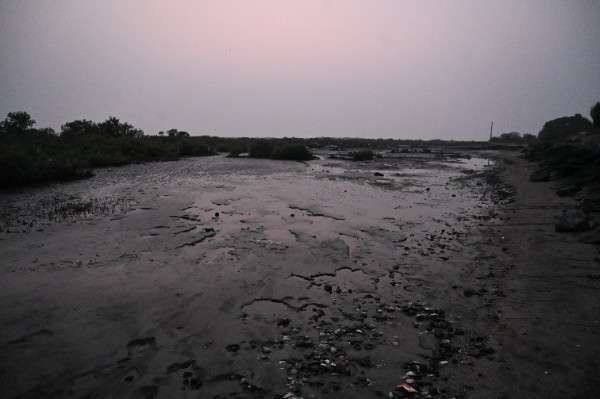
According to the protesters, the EIA report does not adequately consider mangroves, traditional fishing zones, and the environmental impact of the project. They also point out that during a hearing in July 2023, JSW had submitted an affidavit stating that it would not develop a port at this location. However, following the new maritime policy announced by the state government in August 2023, the company submitted a fresh proposal and received in - principle approval from the Maharashtra Maritime Board. In 2026, after the board granted environmental clearance to the project, local anger rose again. Protests, meetings, and demonstrations were organised across Murbe and nearby coastal areas.
What does the EIA report say?
The EIA (Environmental Impact Assessment) report for the JSW Murbe port claims to provide a technical assessment of the project’s possible environmental impact.According to the report, dredging during the construction of the port may increase water turbidity and affect marine life. However, it states that these impacts will be “temporary” and “manageable.”
The report also claims that studies have been conducted on the current quality of seawater, mangrove areas, fishing zones, and the biodiversity of the region. The report also mentions that a risk assessment has been carried out, taking into account possible accidents such as chemical leaks, explosions, fires, and the spread of toxic gases (including scenarios like Vapour Cloud Explosion and Jet Fire). It states that software modelling based on international standards, such as SAFETI and PHAST, has been used for this assessment. According to the report, the risks are within acceptable limits, based on the ‘ALARP’ (As Low As Reasonably Practicable) principle.
Regarding fishing, the report states that the project will have only a “limited impact” and that this can be reduced through proper scheduling and preventive measures. It also proposes steps like water sprinkling for dust control, proper waste management, protection of mangroves, and continuous environmental monitoring.
Why do locals say the EIA report is flawed?
According to local fishermen, villagers, and protesters in Murbe, the EIA report may look complete on paper, but it does not match the ground reality. They allege that the study does not properly consider traditional fishing routes, seasonal fish migration, and breeding areas of prawns and shellfish. While the report mentions a “limited impact” on fishing, locals point out that it does not clearly state how many boats will be affected or how many families will lose their income.
According to locals, dredging and land reclamation in the sea will not just increase turbidity, but may also change sea currents. This could lead to coastal erosion and affect the availability of fish. While the EIA report claims that these impacts will be “temporary,” locals say there is no clear explanation of how long this “temporary” period will last.
Some villagers allege that not all fishermen or women were informed during the survey process. They also say that during the public hearing, many of their questions were not answered satisfactorily. While the report mentions mangroves and biodiversity, locals believe that the importance of environmentally sensitive areas has been underestimated.
In addition, while the risk assessment includes modelling of accidents like chemical leaks and explosions, locals do not agree with the conclusion that the risks are “acceptable.”
“Acceptable for whom?” they ask. According to them, for communities that depend on the sea and fishing, even a small risk can have a big impact. They strongly feel that while the EIA report may be based on technical language, it does not fully consider the lived experiences of villagers, their traditional knowledge, and the long term impact of the project.
Betrayal of trust : No transparency in the project.
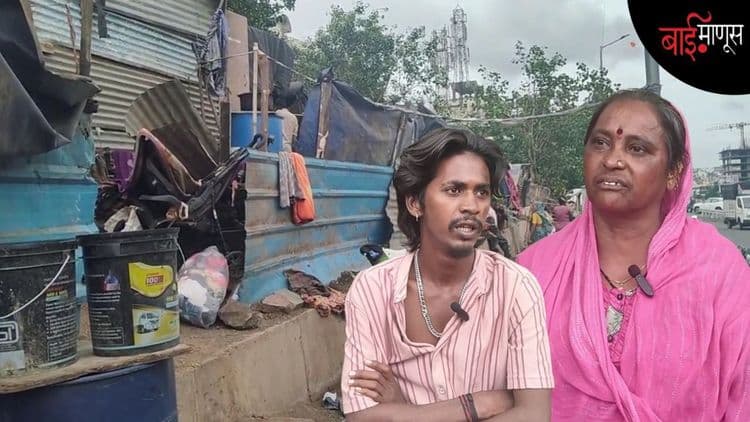
Shaileh Raut, a young resident of Murbe, says,
The reports prepared for this project do not properly consider natural resources like mangroves, coral, and the coastal ecosystem. If the project goes ahead, the livelihoods of two to three thousand people will be at risk. With the Jindal port, there is a possibility that coal and chemicals will be unloaded into the sea, which will pollute the environment and the air. There is no transparency in the government’s process. Drone surveys, boat inspections, and other surveys are being carried out quietly, when people are busy with their daily work. If this project was truly for the benefit of the people, then all these processes would have been done openly.
Ajinkya Dev, another resident of the village, says,
The project will directly affect fishing, which is the main occupation here. Around 80% of the people depend on fishing, while the remaining 20% are involved in farming. If we are displaced, fishermen will not be able to continue fishing or farming in a new place. This will destroy the lives of local people. The committee secretary has also raised concerns about transparency through legal notices and has written to the Collector and SP. But even though the government has accepted the report, local voices and questions were not given space in the public hearing.
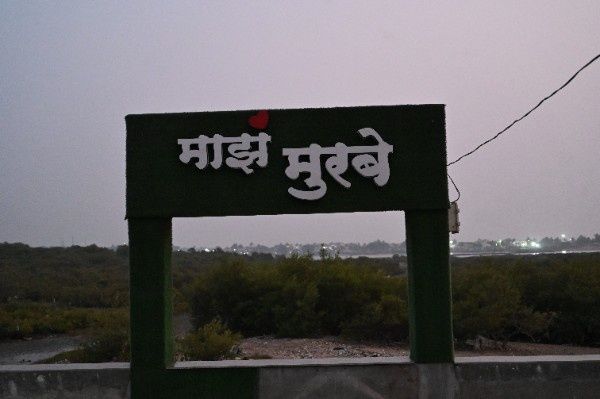
Satpati and Murbe are coastal villages in Palghar district, where the main livelihood is fishing. Together, these villages have a population of over 50,000. A majority of people in this region are directly or indirectly dependent on marine fishing, fish trade, and related traditional occupations. Because of this, a large port project in this area is not just an infrastructure project, it will have long term impacts on the environment, livelihoods, and the social fabric of these communities.
The Murbe port project is being opposed because it poses a direct threat to livelihoods based on fishing and could lead to large scale displacement of coastal communities in Palghar district. Satpati and Murbe are villages that depend heavily on fishing, with thousands of families relying on the sea for their survival. Locals say that decisions affecting their livelihoods cannot be taken without transparent studies, meaningful public consultation, and clear accountability. With this demand, protesters have come together under one clear slogan which is “One resolve : Cancel Murbe Port!”
(Sanjana Khandare is a mentee at the Climate Change Media Hub of the Asian College of Journalism. The program is supported by Interlink Academy, Germany.)
(This story is produced under Project Dharitri, a joint undertaking by Asar and Baimanus on Climate Change & Gender reporting.)