During the 'Save Soil' program organized by the 'Isha Foundation' last year, Prime Minister Modi said, "Friends, I am happy that the environment has been considered in the schemes that have been going on in the country for the last eight years. Be it the 'Swachh Bharat Yojana' or 'Waste to Waste' program,. Under the Amrit Mission, modern sewage plants are being constructed in cities, a plastic-free campaign is being implemented, Ganga is being cleaned under the 'Namami Gange' campaign, solar energy is being emphasized, and ethanol production is being increased. Overall, India is making a lot of efforts for the environment.” The Isha Foundation has been accused of violating environmental regulations. Talking about the environment, Modi strongly advocated his own government schemes while also saying that India has to solve environmental problems due to the world's wrong environmental policies.
In the 2019 election manifesto, the BJP said that 9 thousand square km of forest area have increased in the country during their tenure. He also said that the BJP will strive at the same pace to increase the greenery in the country. He had resolved to reduce pollution in cities by 35 percent under the National Clean Air Scheme. He also said to protect and promote the interests of tribals. During the ten years of the Modi government, many schemes on environment protection and climate change were implemented. These were necessary because the whole world is suffering from environmental problems. Before coming to power, Modi, while filing his nomination for the Lok Sabha elections from Varanasi, had said that he was called by 'Mother Ganga'. After coming to power, the government started the 'Namami Ganga' project,raising the voice to clean the river Ganga. More than 20 thousand crores of rupees have been spent for this till date.

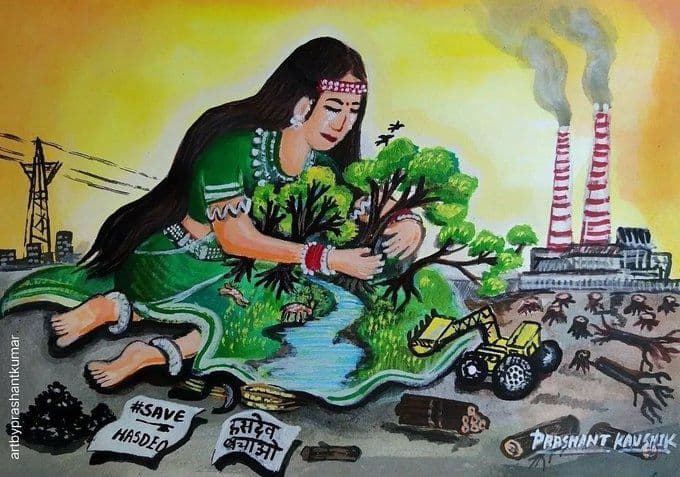
In order to have global fame, the Modi government keeps on making big plans and promises. But the government's policies show a different picture—that there is a big gap between what they say and what they do. Government statistics show that their policies are harmful to the environment and cost the lives of tribals. The government is changing laws related to water, forests, and land to prioritize trade. The government was scrambling to get private companies involved in commercial plantation programs to open up forest areas for them. According to the findings of 'The Reporters Collective', work over this was started in 2015 itself. In 2016 and 2018, more work was done on this through the National Forest Policy.
Entry of large private companies
The Modi government amended the Forest Protection Act, 1980, to free up forest land for the private sector. According to this change in 2022, the government can now hand over forest areas to the private sector for development without the consent of tribals and nomadic tribes. According to the Forest Rights Act of 2006, it was necessary to obtain permission from these groups. In July 2023, the government amended this law to grant free access to the forest to the private sector. The government changed the legal definition of forests. Now, eco-tourism and zoological gardens are also included in the forests. Now there will be no need to get permission from the central government to work on this. According to the new amendments, forest laws will no longer apply to zoological museums, safaris, or eco-tourism. Environment laws were amended several times during the Modi government. The Union government has relaxed the environmental norms with the draft Environment Impact Assessment 2020 and, on the other hand, has tried to strangle the groups affected by it. According to an article in 'Down to Earth', the draft is pro-industrial and violates environmental norms on a large scale. The government, however, says that the draft will increase transparency and speed up processes. The original Act (1986) does not sanction any industrial or infrastructure schemes unless certain conditions are met. Environment Impact Assessment deals with coal and other mines, infrastructure development, thermal, nuclear, hydropower projects, real estate, and other industrial projects.

Ganga is still polluted
But its new 2020 draft gives post-facto approval to new projects. This means that even if a project does not meet environmental safeguards or does not have approval from the Department of Environment, such projects can continue their work. This is very serious because many projects in the country are already underway without the approval of this Act. Public participation was important in earlier drafts. Therefore, a community was informed about the project in its area, and their objections were taken into consideration. In the Namami Ganga project, which the government has brought to great fanfare, only money is being spent, but it does not seem that the Ganga is being cleaned. 13 thousand crore rupees were spent from 2014 to 2022. This project is progressing very slowly. Ganga is still polluted, but its cleanliness is being widely advertised. 36.7 crore rupees have been spent on advertisements till 2018 by the National Clean Ganga Mission.
River linking project is impractical
Another important scheme under the Modi government is the River Linking Project. Experts say that it is impractical and unscientific. According to the government's plan, water from the Brahmaputra and lower Ganges basins in eastern India will be transferred to low-water areas in western and central India through dams and 14,000 kilometers of canals. It is likely to damage the natural environment on a large scale. The BJP, however, is touting the scheme as an effective solution to the annual floods and droughts.
Death of 9 Cheetahs
On Modi's 72nd birthday in September 2022, 12 cheetahs were brought from South Africa to Kuno National Sanctuary in Madhya Pradesh. By March 2023, 9 of them had died. It included three out of four baby cheetahs born in India. Currently, there are 14 cheetahs. According to the news in 'The Guardian', many zoologists were opposing the idea of bringing the Chhetahs to India. Cheetahs were used only to stunt Modi without creating a suitable environment for the cheetahs. The news also said that Kuno Sanctuary is not a suitable place for cheetahs. It was also said that the Modi government will make massive efforts to increase carbon credits. In 2022, the government launched the Carbon Credit Trading Scheme to encourage generation and trading of green credits. This allows trade through tree plantation, water conservation, sustainable agriculture, etc. The scheme mainly focuses on increasing green credit by planting trees on waste land. Modi has repeatedly announced on international platforms that India is committed to achieving net-zero emissions by 2070. Modi said at the G-20 summit in Indonesia that India is on track to achieve a target of generating 50 percent of its electricity from renewable sources by 2030. The government has also banned single-use plastic. It has been completely banned across the country since July 1, 2022. But the responsibility of implementing this rests with the state governments and their state pollution control centres. Hence, there is a clear lack of coordination and confusion about who should take responsibility. Therefore, this ban has not been fully implemented.

In the ten years from 2014 to 2024, Modi made big announcements about environmental protection and climate change. Many promises and appeals were made on international platforms. India ranks lowest among 180 countries in the Environment Performance Index. India was ranked 155th in 2014. In the name of promoting trade and simplifying the investment process, the government has neglected environmental protection. According to Article 14, the Ministry of Environment has approved three large hydropower projects by the Adani Group in the ecologically sensitive forests of the Western Ghats. For this, the rules were changed. It is likely to get approval for two more projects from Adani. This shows that the Modi government has continuously violated environmental norms in the name of development and industry. But the Modi government has been least criticized in this regard. It is a matter of concern that the government's responsibility and policies on this issue have not been discussed as much as needed.
Translation – Pratik Puri
(Courtesy – Feminism in India)