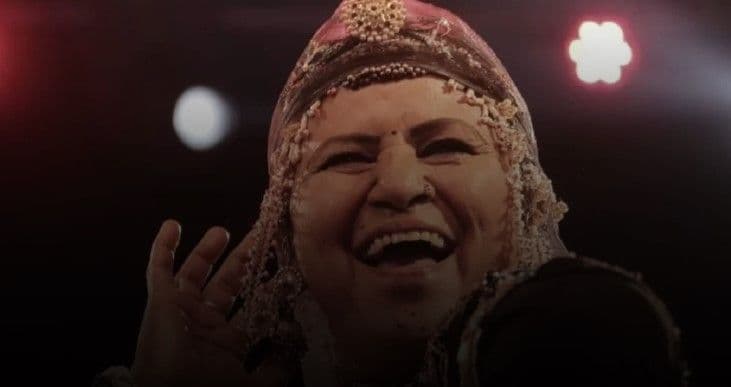
Kalbelia dance originated in Rajasthan. The reason why this dance is called Kalbelia is that it is a traditional dance of the Kalbelia community. These people keep snakes and exhibit them. Kalbelia dance was earlier considered to be a dance form performed only by men. Only a small group of women were allowed to perform this dance. Women could also participate in the Kalbelia dance along with men after some conditions were imposed. Not otherwise. This situation started to change in the eighties. Gulabo Sapera , a Kalbelia dancer, started making a name for herself in this dance form. She was getting fame as India's 'Gypsy Queen'.

Gulabo Sapera was born in a nomadic community. The childhood of these children was difficult. Gulabo was no exception. In the Kalbelia society, if girls are born, they are buried alive. Many babies lost their lives. Gulabo says that her parents were afraid that if they had a daughter, the rest of the people would bury her alive. They did not accept it. So they both left the village and came to live in the city. But the Kalbelia people always live in the same tribe as each other. So Gulabo could not escape from this custom after birth. She says,“ I was buried alive in the soil for six hours. After that, my mother pulled me out of the pit with the help of my aunt. I was alive. Mother believed that God had graced me and saved me. When I was a child, I used to ride in a snake basket with my father for a few years. Because my father was afraid that if I was left alone at home, other people in the community would kill me. My mother saved my life. I also saved my daughter, taught her. "
She continues,“ Since childhood, I have loved the sound of the bean (pungi) and its rhythm. I have grown up with snakes since childhood. That's my first friend. I loved playing with them. Baba used to feed me the milk they would get. Men in our society remove the poison from snakes, knock out their teeth and make them dance to the tune of Bean. We live on the money we get from them. "

Rebellion for black clothes
Black clothes are very important in Kalbelia dance. But women are forbidden to wear these black clothes. Talking about this, Gulabo says, it was not an easy journey for us. Until 1985, Kalbelia women were not allowed to wear black clothes. I was twelve years old at that time. I earned some money while dancing at the Pushkar Mela. I loved the color black. So I insisted on my father about black clothes. But he refused. Even after they refused, I did not give up my stubbornness. Finally, my father listened to me. They did not care much about society.
He brought me a six-meter long black cloth despite knowing that we might protest. But if we wanted to make both ghagra and choli, that clothes is a little less for that. Then I went to the market and brought more colorful clothes, glass beads, pearls, thread, etc. I applied colorful pieces of fabric to the black fabric. Then glass balls, beads, pearls, etc. were used on it. The original black cloth was not visible. Since then, Kalbelia women started making and using the same dress while dancing.” Kalbelia women also dance in black clothes now. Ghagra-choli has become their official dress. But for this reason, Gulabo also had to face a boycott from his community for some time. But they did not back down. His mind was rebellious and his will to do something was strong.
Rules imposed on women in Kalbelia society
- Women had to dance with bare feet while dancing.
- It was customary to wear a long veil over the head covering the entire face. Protect them from public view
- In the name of keeping, this practice was abandoned.
- They were not allowed to dance on stage.
- Kalbelia women were not allowed to wear black clothes like men.
- The women of the caste panchayat had no freedom of speech.
- Women were not allowed to go outside society and do any work.
The literacy rate in the Kalbelia community is only 2 percent. The first educated woman in this community was Gulabo's daughter Lineis. With the passage of time, some changes have started happening in this society. Gulabo Sapera went abroad for the first time. After that, their society began to adapt to change. But still, this society is far behind compared to others. Gulabo got fame after working in the series 'Bigg Boss'. There were many changes in his life. She says that it was the first time that she appeared in front of people without a veil. This was a very different world from their Kalbelia world.

Gulabo Sapera's first foreign trip
Gulabo says about his foreign journey that this journey was very difficult. She was going to America for the first time abroad. She says, “At the 1981 Pushkar Mela, officials from the tourism department, Trupti camee and Himmat Singh, came. They saw my dance, they liked it and from there I got an opportunity to go abroad. I didn't feel much after boarding the plane. Because I was so happy that I couldn't think of anything else." He sang and danced in America. After coming from America, the attitude of the people of their society towards them changed somewhat. At the age of 12, he was made Panch in the Jat Panchayat. People used to take decisions by asking them. But he wanted to send girls to school and teach them dance. He was also aware that we had to do a lot more work for that. During a tour in Spain in 1993, Gulabo danced to the music of the guitar, which made her famous as the 'Gypsy Queen' of Rajasthan. In 2004, Gulabo's fame rose further when he danced in Jaipur to the rhythmic music of Robin Tikhathi.
Dance similarities between Roma women and Kalbelia women
Gulabo says, “The Roma are of Indian origin. There is no language problem with them. Even while dancing, there is a similarity between our dance postures and clothes. Kalbelia dance and gypsy folk dance is a flexible, dynamic dance form of snake-like swinging. The Kalbelia dancer wears a black blouse and a long circular ghagar, decorated with colorful ribbons, glass beads. A Romani gypsy dancer wears a long skirt and blouse. It is also colorful. Both dancers dance with bare feet, swinging their hips. Kathak, Kalbelia dancer-dancers, European Roma dancers, Flamenco dancers, there is a lot of similarity in the costumes.” Gulabo has set up a school for girls in Pushkar to promote Kalbelia dance. In recognition of her performance in dance and singing, the Government of India honored her with the 'Padma Shri' award in 2016.
 The President, Shri Pranab Mukherjee presenting the Padma Shri Award to Smt. Gulabi Sapera, at a Civil Investiture Ceremony, at Rashtrapati Bhavan, in New Delhi on March 28, 2016.
Translation: Pratik Puri