The most recent story is 10th and 11th June 2023! The first tribal meeting of Maharashtra was held at a resort in in Kalamba area of Kolhapur. This meeting became historic in many ways. There are a total of 75 primitive tribes in the country. There are three primitive tribes in Maharashtra, namely Madiya, Katkari and Kolam. The meeting was organized by the organization Koro India, which brought together representative activists working at the ground level from these three communities. This is basically the first time that the representatives of these three communities have come together in Maharashtra. Even after 75 years of independence, these primitive communities are still deprived of basic amenities. Keeping faith with their custom-tradition-culture, these communities live by calling them 'Yala Jeevan Aise Naam' without any complaint. But no one who is considered sensitive to these community issues seems to be speaking up. This is equally true.
A community where the death rate is higher than the birth rate, a community that depends on water-forest-land for livelihood, lives in a specific land area and has a low educational background. A survey was conducted by the central government in the 1960s on the basis of some such basic criteria. From this a list of primitive tribes was prepared. 75 tribes of the country have been included in this. Special provisions have been made in the forest rights and some other laws to protect and preserve the customs, traditions and culture of this community, which has been wronged for generations, and their rights remain intact. Some schemes have also been prepared to bring these tribes into the mainstream of development. But they are still on paper. These communities have separate festivals-traditions and languages. But this cultural heritage of this community is gradually disappearing. The encroachment of other mainstream communities on these communities is also shocking.

Considering the demographic and geographical existence of the primitive tribal community in Maharashtra, the Kolam community resides in the remote areas of Nanded, Yavatmal and Chandrapur districts. According to the 2011 census, the population of this community is only 1,95,671. Katkari community is in the Mumbai-Raigad-Thane-Palghar urban area and the population of this community is 2,85,334. While the Madia tribe lives in the remote and Naxal-affected areas of Bhamragarh, Etapalli, Aheri, Chamorshi, Dhanora in Gadchiroli district, the population of this community is only 62,000. At present, the population of these communities is either stable or declining. Will these primitive communities disappear in the future? This cannot be denied. Only 19 people of the primitive Onge tribe and only 29 of the primitive Jarwa tribe remain in Andaman and Nicobar states. The risk of extinction of these communities cannot be ruled out. These communities have separate cultures, customs, traditions. But the question of its preservation and conservation has always been neglected. In the era of globalization, human life and their habitat are being threatened day by day, along with the culture of primitive society. We, who consider ourselves educated, set them free as barbarians, superstitious, poor, and do not understand the humanistic riches among them; Naa thinks deeply about their culture. Perhaps that is why the cultural accumulations of these societies do not proceed constructively.
The level of education is still low in primitive communities. Due to the lack of rooting of modern ideas in society, the amount of superstition can also be seen. These communities are located in forested areas, but they cannot claim the rights of water-forest-land. Can't even put it. There is still ignorance in this community about constitutional values. Therefore, the strangulation of rights is a regular rule. The exploitation of society by government-administrative-political leaders is increasing day by day. Due to this, the existence of these primitive communities is a big question. At the present time, the policy of displacing the village councils of this community by setting up various factories and illegal mines without taking any permission of this community, without taking any opinion of this community and displacing them can be seen. Their customs, traditions, culture, language are disappearing and the problem of employment and livelihood is becoming dire.
At present, there is no state or national level organization of primitive tribal communities, not only in Maharashtra but also across the country. There is no desired position in political office. Those who talk about them and raise problems are also not at a special level. In such a situation, it is very important to implement special programs and measures for the development of these tribes and the protection and preservation of their cultures. For this, extensive and continuous efforts must be made by the citizens of this tribal group, the mainstream society, the government, other civic organizations-organizations etc. It is imperative to think about the socio-cultural aspects of the primitive community and their issues, economic and political injustice. It is necessary to work with the local leaders of the same community to eliminate the challenges and problems in the implementation of plans and laws in the primitive community. If a social movement can be formed with the organization of all the three primitive communities and exchange of ideas, positive thinking and brainstorming can be an important step in planning the next direction and policies.

In the 1st primitive meeting of Kolam, Katkari, Madiyas held in Kolhapur, the first lawyers of Madia community Ed. Lalsu Nogoti, Buklu Lekhami, Ajay Atram of Kolam community, Devu Sidam, Namdev Kodape, Kunda Waghmare of Katkari community, Mahendra Rokade of Koro, Kunal Ramteke, Pramod Valde, Avinash It is necessary to work on the questions and issues raised by this community on the initiative of Poinkar and Amit Kulkarni. A total of 9 resolutions of this community were unanimously passed in this meeting, which are as follows;
Resolutions Passed in Adim Samamel:
1. The customs, traditions, culture, language, traditional structures of the primitive communities of Kolam, Katkari, Madia in Maharashtra should be preserved and preserved. For the preservation of the culture of the primitive community, the government should set up a separate study and research center and museum in the working area of this community. It should represent the primitive community.
2. There should be special preference and reservations for jobs, schemes, education, hostels for primitive tribes. The government should establish a separate corporation for the development of Kolam, Katkari and Madia communities in Maharashtra.
3. Special schemes for primitive communities and the Pesa, Forest Rights, Biodiversity Act should be effectively implemented. For the preservation and conservation of the rights and culture of this community, there is a provision of 'HABITET RIGHT' under the Forest Rights Act and the government should agree and provide 'habitat rights' in the area where these three communities live.
4. Kolam, Katkari, Madiya have separate native languages. Shasanna's language should be accorded native language status.
5. Special representatives from the tribal communities appointed by the Governor and the President should be appointed by the Legislative Council and Rajya Sabha to bring the leadership of the tribal communities and their issues to the mainstream.
6. Adim Madia, Kolam, Tole, Pod, Vasti of Katkari community should be accorded the status of revenue villages.
7. The issues, problems and problems of women of primitive Madia, Kolam, Katkari communities are different from the problems of women of other communities and the government should start special primitive people's commissions, tribunals and local centers to solve the problems, problems and problems of women in these communities.
8. Special measures should be taken for health and education. Primitive communities have a female-dominated culture. Girls and women should have a special place and reservation at the government level.
9. Surjagad iron ore project is going on in the 5th schedule area of the Constitution of India, where the primitive Madiya community resides in Gadchiroli district, against which the primitive Madiya communities are protesting. Public support is being given to the said movement on behalf of the primitive communities of Madia, Kolam and Katkari. Also, no project should be carried out in the habitations of primitive communities without taking the prior permission of the community and gram sabhas.

Do primitive tribals only want to dance?
Even though Maharashtra has many Gond, Halba, Pardhan and other tribal communities which are far from development, should they be branded as backward and restricted to dancing in the name of culture, festivals and ceremonies, to welcome political leaders, leaders and officials? This tune is now being picked up by primitive tribal activists. Ignoring the basic questions of food, clothing, shelter, health, education, telling them how great the culture of the tribes is, they used to keep them dancing all night long with Rela, dandar, and did politics in their name. This picture is no longer hidden. In the village of Madia community in Gadchiroli, every festival is held in the area of Gotul, where the young and the young get together with joy. Kolam performs Bhusari Nutya by putting ashes on his body and wearing a big cap decorated with peacock feathers on his head. Although other communities are looking at all this with excitement, are we going to understand the modern distortion of this culture or not?
Sociologists have said that young men and women who dance in Rela in Gotul choose their partner and go out into the forest at night to have physical relations. It is their freedom. These primitive communities to have been living on water-forest-land since time immemorial impart their traditional knowledge to Gotul. 'Gotool is the university of tribals'. This modern setup is needed. It is unfortunate that tribal culture does not have the expected place even in the university in the area where, the tribal community resides. It cannot be denied that universities, social institutions, organizations wave grants in the name of special tribals, but ignoring their sustainable development and traditional knowledge, tribals are kept only for dancing. The reality of the Sahitya Akademi award-winning collection of stories titled 'Adivasi Nahi Nachenge' is telling.
When will the indigenous tribal leadership come forward?
Traditional leadership still holds a special place in the primitive tribal communities of Kolam, Katkari, Madia. If someone's health deteriorates, people first go to a priest or herbalist instead of a hospital. Before independence, when primitive tribal communities lived in forests, their lifestyle was more disciplined. Of course, he had and still has the knowledge and skills to lead the entire group responsibly. In the Madia community in the forest of Gadchiroli, the traditional local leadership of Perma, Bhumia, Gaita, Kotla, Pujari still exists in every village. Perma means the head person of the village. Like the president of the village. Bhumia means the owner of the land in the village. First, the Bhumia sows the seed in the ground by pandum and then other people do it. Even after the death of a person, he decides where to give place for his last rites. Gaita means Gaon Patil. Head of the village decision-making process. Gaita's main job is to doing justice by knowing comprehensive opinions and take decisions in the interest of the village with the consent of the villagers. Kotla now means Kotwal.

Works to share information about special programs, festivals and trips to the people of the village and locality. Pujari is responsible for worshiping nature deities during various festivals and ceremonies throughout the year. The Kolam community also has Naik, Mahajan, Karbhari, Ghatya, Tarma, Bhumak etc. in the judicial system and village level leadership. But with the passage of time, their identity is erased now. In fact, the local leaders have a more important position and respect in the community than the sarpanch, sub-sarpanch, members of the village gram panchayat. This local leadership used to run the village train. But at present they have no documented identity at any level. For the identity and habitat of these primitive communities, the Forest Rights Act provides for area rights. However, none of the primitive communities in Maharashtra could take the initiative for local government. There is no simple record of this traditional leadership structure, their working methods and their attitude of absolute service.
It is necessary for the government or the Integrated Tribal Development Department to honor their service and knowledge by giving identity cards to these traditional leaders. Primitive Development Commissions of central and state governments do not have activists from primitive communities. There are only representatives of organizations and associations. There is not a single person from the Kolam, Katkari, Madia communities of Maharashtra on the Center's Commission for Primitive Communities. If no activists from the tribal community are included in the development plan of the tribals, it shows how insensitive and blind this government is. Basically, 'those who question should lead'. But the picture is seen all over the country when leadership is done in the name of tribes. The reality is that others are moving forward using local leadership in primitive tribal communities. Local leadership among tribes is very powerful. There is a sense of unity. Now there is a need to hand over the leadership of the primitive tribals to the tribals themselves.
In the struggle for development and displacement, we are also neglecting...
On the lips of those who are considered modern and advanced or on the government documents, the three tribes of Kolam, Katkari and Madia are extremely protected, or the government has done injustice to this primitive community, even though it has been mentioned in the law that it has been seventy-five years of independence, but the development has not made much difference. Roads, electricity, communication, health facilities, networks, education are still not reached where these communities are living. People have no work. Migration rates have increased. The missionary work of Christian missionaries is going on in full swing and village after village has been converted. The situation of Katkari community near Mumbai city is no different. On the contrary, at least the winds of change have started blowing in the Kolam and Madia communities living in the forest area.
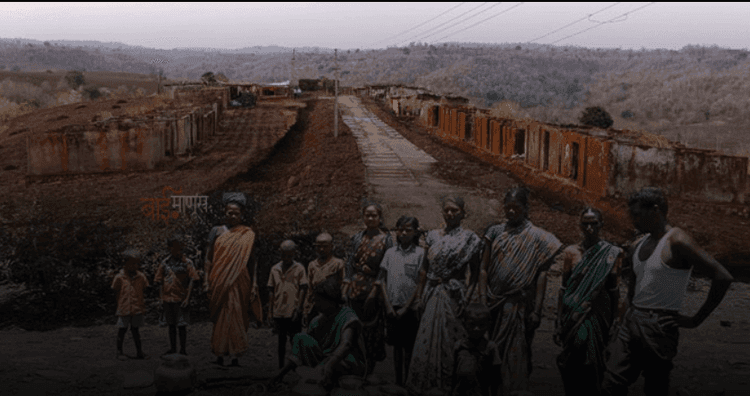
It is unfortunate that the tricolor had to be hoisted for the first time two years ago, i.e. in the 74th year of independence, in Ghodankappi village of Adim Kolama in Jivati taluka of Chandrapur. There are many padas in remote areas where even the tricolor is not hoisted. In fact, the primitive tribal community is extremely prosperous., It is naturally rich. We cannot measure their wealth in money. Concrete roads and drains are not development, but the focus of their development is to sustain the desire to survive for generations by making proper use of natural resources without disturbing nature. But while the basic facilities have not yet been completed, the black cloud of displacement has hung over these communities, no one cares or regrets!
 Ghodankappi village
At present, more than 30 people's agitations are going on in central India for the protection of water, forest and land of tribals. However, attempts are being made to suppress the agitations based on constitutional values, to demonize the activists, to demonize the tribals by spreading rumors, accusing them of supporting Naxals. Non-tribal activists working in the name of tribals, however, are not seen as tribals in this struggle. Much is written and discussed the problems of the Katkari communities near Mumbai, Palghar, but efforts to bring forward their leadership to be included in the mainstream are not strongly visible. The situation is no different in Kolam pada in Yavatmal, Chandrapur district. Due to the exploitation of this community by other communities, land grabbing, Kolams is also in a bad condition. An exploratory survey of the Kolam dolls in Chandrapur was recently conducted by Jagurt Sanstha, in which 77 percent of the Kolams did not even have a say in their people's representation.
It came out that the rate of child marriage is still high. The primitive Madiya community of Gadchiroli which worship nature, has preserved its traditional, cultural, spiritual, natural heritage. But the area where this community lives has a large amount of mineral wealth and Surjagad iron ore mine has been started. Again, 6 quarries will be started there. Again, quarries are proposed in the hilly areas which are the gods of tribals throughout the district. It is time to displace the forest-dependent primitive Madiya community. Since March 11, local Madia tribals have been on anti-mining agitation for more than 250 days. But there is no official record of this movement. The government has not taken any notice. In fact, the hanging sword of displacement that hangs over the primitive Madiya community is certain to fall upon the 75 tribal groups of the country who rely on forest-based livelihoods. Exploitation of primitive tribals in the struggle for development and displacement, deliberate neglect, flouting of Pesa and Forest Rights Act; The very existence and identity of tribals has become a question.
In fact, even we who consider ourselves educated pay attention only to the culture, tradition, language, living conditions of the primitive tribal community. But they never pay attention to the basic questions of life and death. We say that where there is a forest, there is tribal. In fact, it is tribal, so our tongue hesitates to admit that it is a forest. The primitive tribal community is prosperous. But even if we realize that we should not be the cause of their neglect, we will gain a lot.