I was listening to a Chhattisgarhi folk song about tattoos. 'Tor naam ke gondana gondaev, mare maya ke chinhari bar, abbadmaya tola karbhav, maya pirat ke phulwaribar, gondaful karu hamar maya, fulat rahay maya ke bagiya man' I took a deep dive into these songs. During the day, I was surrounded by moonlight tattoos. The peacock tattoo in my mind started dancing. These tattoo songs left such a charm on my mind that I never knew that the tattoo embroidery had fallen off while I was rocking to the rhythm of these words. If this feeling of love is not attractive to the tattoo song, then what is life, and what is love? And here, the weaving of emotion, love, art, rhythm, rhythm, words and melody is woven. Then someone's mind will try to unravel this primitive folklore of tattoos and start to push directly across the human origin.
Ever since I was a child, I have saw numerous tattooed marks on men and women's shoulders, arms, legs, and faces, the hidden curiosity about tattooing woke up once again, and I started looking for the story of the crescent moon, moon dot, morankshi from single dots and lines.
What exactly is tattooing? Then the history of tattooing started unfolding one by one. Tattooing is a symbol of adornment, beauty, love, modesty, chastity, chivalry. A tattoo is a mark of remembrance of a loved one. Tattooing is a primitive art that fascinates everyone. Gondan is an attractive tattoo done by cutting the body with a sharp tool of thorn, stone, shell, metal, bone, fish fork to create a picture and symbol. In which the color of tree leaves, bark, coal color, special soil, woman's milk, carrot juice, turmeric powder etc. were filled.
This Gondang song, hummed by the lips of primitive people, still enthralls the minds of many people. This Ivlis tattoo covers the entire human existence. We see it covering society, culture, art and literature, song and music etc. From 'Gondan' to 'Kalaj Gondan' one can find several titles in Shanta Shelke's collection. We read innumerable poems like 'Nadichi Vene Nagmodi Katlala Zarya Che Gondan', 'Maunachan Dehawarati, Songe Gondan Hoe', 'Tujya Na Naa Gondan Left-hand Var Mirvin' or 'Tujya Dalimbi Vatanen Ghyavan Kapal Gondon'. There are also thousands of references to folk songs and folklore. Many folk beliefs and myths have been created, like 'Nandoon Aalees but Gondoon Nahi Aalees', 'Lagam Vatara Khanai Panan Kami Koni Dhanai' (You got a lot of tattoos, but there is no bottle) and 'When a man dies, only the tattoo on his body goes with him'.
This sky tattooed moon on the back mirrors Shubha Gokhale's studio as 'Gondangaon'. From the common person, Bollywood also works its magic on the Mayanagari like Hollywood. It is true that tattooing is painful, painful, and life-long; but the beautiful experience after that is for a lifetime. Its joy and intoxication are something else. That is why most people today do not shy away from getting tattoos on any part of their body. Such is this hypnotic tattoo song.
It is not certain about the beginning of tattooing, but the history of tattooing can definitely be traced back to when the art was introduced to the primitive person. It is truly an art born by tribals. Even in primitive times when clothing was not invented, tattooing became a practice among tribals for body adornment and shame protection. Tattooing may also have come into existence due to wounds on the body while working and infusing pigment into it, resulting in permanent ulcers or fear of supernatural forces. Herbert Spencer has expressed the idea that the person should be protected by her.
Neuburger Mocks said that this form may have started from a medical procedure. There are many reasons, such as to maintain the uniqueness of our tribe, for identity, for religious reasons, to increase sexual attraction. But beautification seems to be the main purpose. Overall, the journey of tattoo art has been from ancient times to urban, modern.
Tattooing has been preserved and kept alive by numerous tribal nomadic people groups around the world.
Searching for the historical context of tattooing 5300 years ago in the Neolithic age, 'Otzi the Ice Man', a primitive person from the Otz Valley, was found with 57 tattoo marks on his body. In 1948, the body of an old tribal chief was found in a frozen tomb in Pazarik, 400 years after Christ. On his body were tattooed images of a donkey, donkey, deer, bird, fish, buck, a demon. In Egypt and Sudan, mummies of women used to have tattoos on their bodies and faces. Symbols of God are tattooed on them. The thighs of courtesans and diplomats were tattooed with fish forks. Barbarian chieftains are depicted in ancient Greek literature. In Japan and China, necks are a place of honor.
This art was advanced in the Maori world of New Zealand. American Red Indians, and tribals around the world were tattooed on their bodies. Scholars believe that this art from the Far East was brought to Europe by gypsies through India. This tribal art was forbidden by the Bible. The Prophet also forbade it. Even Vedic literature does not find mention, but over time Hindu culture adopted the art of tattooing. This art was practiced among the Dravidians. In urban culture, it has so far been scorned as a sign of village or barbarism.
 Tattooing has been preserved and kept alive by numerous tribal nomadic people groups
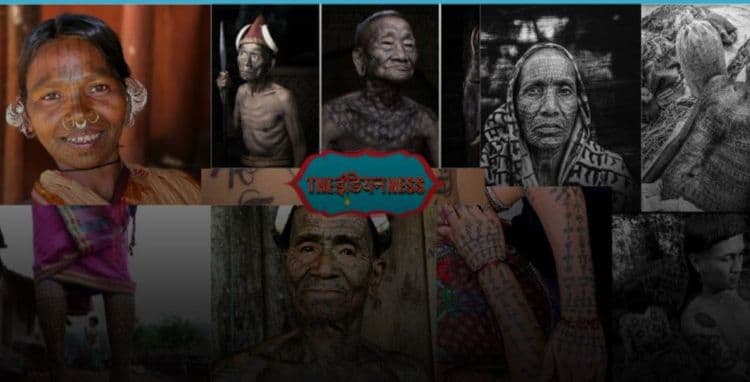
around the world. Therefore, as a symbol of nature and good and evil forces in nature, it has remained at the center of their lives and art. Hence, the symbolism of primitive civilizations is found in it. Various forms of nature are embedded with specific meanings and understandings. Figures of bodies, peacocks, fishes, swastikas, pictures, butterflies, stars, floral-embroidery, lions, suns, dragons, scorpions, birds, fairies, various types of figures, dots, lines, are embroidered. Women tattooing on cheeks, forehead, chin, chest, breast, back, waist, legs, groin, wrist, neck etc. Men are tattooed on their arms and legs and on their chests. The practice of tattooing the name of a loved one, husband, brother on the hand is still seen. Among tribal nomadic groups, tattooing is more important than jewelry. When the daughter-in-law leaves, she carries only the tattoo as a reminder of Maher. Tattooing has a special attraction among women.
Tattooing can be seen to have evolved into many customs around the world. Among the Solomon Island tribes, a girl is not eligible for marriage unless she is tattooed on her face and chest. In Australia, tribals tattoo a girl's back before marriage. In Taiwan, a girl's face is tattooed before marriage. In the Paupuan tribe, a girl is tattooed all over her body. In the Naga tribe, young people get married only after getting tattooed. Some symbols are tattooed, like Kulachara. Tattooing adds beauty. Many speculate that tattooing may have something to do with acupuncture treatment.
There are many practices, like knee tattooing for knee pain, forehead tattooing for headache. There is a belief that body tattooing in kolams does not remove the goddess. There is a belief that there is no crisis at home in Warlis. Moreover, tattooing does not hinder ghosts in the wilderness. It is also believed that because of Gondana, the husband gets a long life and love lasts. In fact, tattooing reflects the accumulation of our culture. We see modern civilization rising on the head and shoulders of primitive civilizations.
Today, while walking in metropolitan life, if you look at a group of young women, women and youths, you can definitely see a small and delicate tattoo on the hands and necks of two or four. Today's youngsters happily get tattooed on the body parts they want. While many traditional arts are dying out in the age of fashion, tattooing is truly flourishing. Hundreds of stars, like Angelina Jolie, Menang Fox, Pamela Anderson, Emma Stone, Kevin Peterson, David Beckham, Mike Tyson, Rock, Brad Pitt, Akshay Kumar, Deepika Padukone, Priyanka, Kangana, Shruti Haasan, Ranbir Kapoor also forgot this tattoo song. Therefore, it has to be said that the older the primitives' addiction to tattooing, the deeper it is.