In Europe, the Roma community is considered a nomadic community. Thousands of years ago from India, these people entered Europe from Rajasthan, Punjab and other regions. The Europeans started calling them Gypsies, believing that they came from Egypt. Professor Markel Courthiade According to him, “Roma is an integral part of India. Indians and Romani people are connected to each other on cultural, genetic, linguistic, physical, social, spiritual and emotional levels. It is the largest minority community in Europe." The culture of the Roma community shares its identity with Indian culture.
Their social behavior is also Indian. According to traditional practice, Roma believe in a joint family system. Roma society is also patriarchal. In Roma households, the headman is the provider and leads the others. Women take care of the house. Men work outside. Roma women are still deprived of higher education. Their practical life is involved in traditions and customs. Director of Porta Rome Por Integrity, Albania, Fatmira DajlaniOn June 20, 2020, at the Virtual International Roma Conference organized by the Center for Roma Studies and Cultural Relations, 50 percent of Roma women have not attended school to date. Although there is a lack of education in both men and women, it is higher in women. Due to illiteracy, these women face many forms of exploitation and violence. The roles of Roma men and women in the family are traditional. This clearly shows their Indian origin.”
 Romani people (Roma or “Gypsies”)
An Indian researcher researching the Roma community, an Indian heritage dating back hundreds of years, Zamer AnwarSays Roma and Indian culture are intertwined. Their lifestyle is rich with Indian values, customs, beliefs, habits. Some Roma scholars argue that the unification of Roma culture is due to their centuries-old Indian heritage. This is what their tradition of joint families dictates. Giving importance to relationships in the family, having elders' approval for marriage, teaching girls to respect elders are Indian things. The only difference is that, with the passage of time, Indian society is changing, modernizing and Roma people are still there. Even today, child marriages occur among them and it adversely affects the education of girls. The elder members of the family take the decision of marriage, which is binding on the girls. They do not have the freedom to choose their partner.
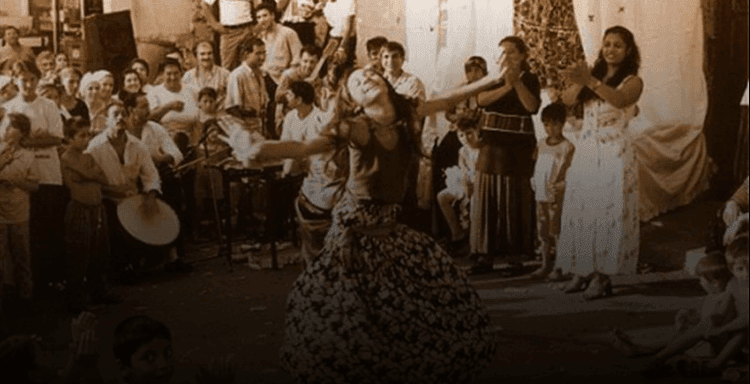
At the time of marriage, a Roma bride is smeared with henna and dressed in white silk. During the henna ceremony, the girl receives gifts from the elders. During the music ceremony, the people of Mulikad and Mulakad dance together, sing and hug each other. At the time of marriage, the bridegroom wears a necklace of pearls which she never takes off from her neck. Our Mangalsutra is also similar. After marriage, a girl is left with her family. After she comes of age, she is sent to her in-laws. This is called 'Jeta'. We had the same practice. Roma stereotypes about virginity have been contested by many Roma women and men.

According to the Refugee Women's Resource Project, Asylum Aid March 2002 report, Mercedes Porras, a Spanish student and social activist, says, “I see myself first and foremost as a person, then as a Romani. I have my own thoughts and I don't intend to change them. As a Roma woman, I am independent of the expectations placed on me. I am a woman who loves her career more and such women are not recognized in our society.” Roma women are fined for 'virginity violation'. Roma women are fined for 'virginity violation'. As there is patriarchy in every place, such a thing is looked at in the way like 'Abru Dhulis got it'. Along with political and social discrimination, these women are also deprived of many basic human rights. E.g. Education, house, job etc.
Roma women often face persecution due to cultural dominance, superstitions, and complex traditions. Sexual violence, verbal abuse, mental trauma, physical abuse, threats are always there for them. Child abuse, incest, violence against women, rape also happen. Romani women are not behind in the misunderstandings and superstitions that are observed about women due to menstruation. In that regard, Indian malpractices seem to be continuing there as well. In the Romani language, menstruation is called 'makhro'. After menstruation, women do not have access to the kitchen. New clothes or utensils are not allowed to be touched. Men's clothes are not allowed to be washed. During this period, women are kept separate. Absentees are not even given food or allowed to touch it. This has bad mental and emotional effects on the minds of these women, Which may be chronic.
 Romani people (Roma or “Gypsies”)
Roman society is dominated by patriarchy based on age and gender. Women have a lower position. No one cares much about their safety and education. Women are totally dependent on men. They have no right over their own choice of sex, martial life. Children are not given birth very far apart. So, mentally and physically, they are always weak. Patriarchal social structure, child marriage, women's burden on children, household responsibility are the characteristics of survival in all Romani cultures. Gender ideas among the Romani people are influenced by patriarchal ideas. In this community, the roles of men and women are fixed. Women are deprived of justice and economic rights. They are still expected to obey the custom.
 Romani people (Roma or “Gypsies”) make up around 3% of the population of Romania. These images were shot inside a Roma village while working with Ovidiu Rom, a non-profit organization based in Bucharest whose mission is to mobilize public and private resources to ensure quality early education is available to Romania’s poorest children. Image by “Shea Winter Roggio”/©SheaWinterPhotography
They have to take care of the house and take care of the children. Unemployment is high even among educated women. On the other hand, poor women cannot learn. Most make bamboo baskets for a living. Divination by looking at people's hands is also widely practiced. Many non-governmental organizations are working to improve the lives of Roma women. But to that, government schemes should also be added. Only then can their lives take a new direction.