'Tata-hot,
Isto-vistav,
Anghlai-anghol,
Shela-shile,
Shirav-broom,
Fuglu-to fill the stomach,
Shetlya-sarda.
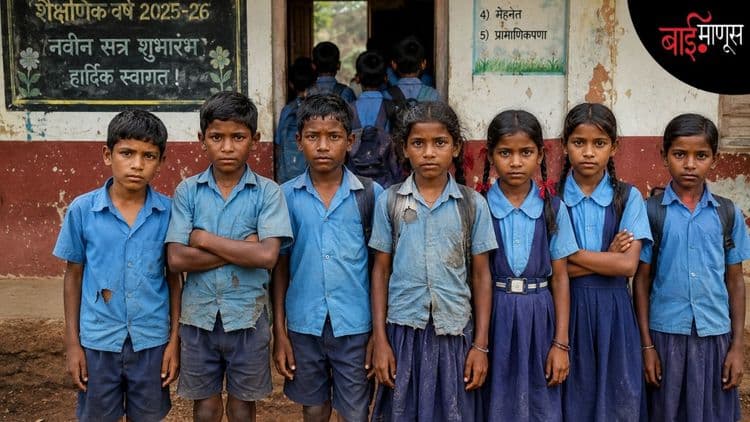
Here are some words of tribal dialect. Teachers of an enterprising Zilla Parishad school in Trimbakeshwar taluka, bordering Gujarat state, have created a chart of words in the local tribal dialect and their equivalent language meanings and painted it on the school wall. So that the children will see it and recite it as they go.
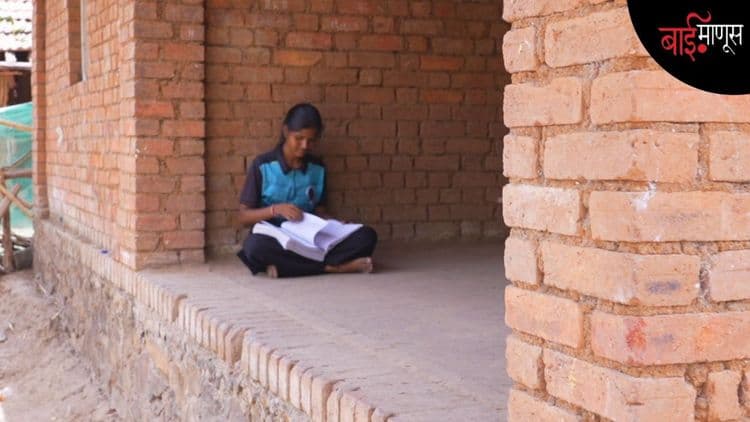
'Actually, I was also a tribal student from Thanapada near Harsul. Our language is different and the book is different. Because of that, I faced a lot of difficulties while studying in school. But when I became a teacher myself and started teaching in a village school in a remote area, I taught subjects in both languages. At first, the children had difficulty, but later we compiled a collection of tribal dialects and standard languages and put the chart on the wall.
Now the children speak both languages very well. What's more, apart from Marathi, they now have a good knowledge of Hindi and English as well -... Keshav, an experimental teacher from Zilla Parishad Hiwali, was sharing his experience in the village. Keshav Gavit's education experiments in ultra-remote areas brought the winter into the limelight in no time. Now the situation is that teachers, educationalists, officials are coming from different parts of Maharashtra to see their educational experiments.
What's more, people from neighboring Gujarat also come here. 'Education through mother tongue is the need of the hour, but the mother tongue of tribal children is different... but I taught accordingly and the children continued to learn.' Mr. They were telling in the village.

Nashik district has tribal areas like Trimbakeshwar, Peth, Surgana, Dindori, and Igatpuri. The dialect here is different from the native Marathi. The dialect of tribals in neighboring Jawhar and Mokhada areas is also different. In Akkalkuwa, Dhadgaon-Akrani, and Taloda taluks of Nandurbar tribal district adjacent to Nashik, the tribal language is even more different from that of Nashik-Thane district. The language here is 'Pawara' or 'Pavari'.
Pawari is the main dialect of the Pawra tribe and it is influenced by other languages spoken locally and around. The Pawars on the banks of the Narmada in the north of Nandurbar district are called Noddalaya, those living in the hilly areas of Akrani (Dhadgaon) taluka are called Bharvatya, Shahada, Taloda taluka, and those living in the flat belt of Shirpur taluka of Dhule district are called Dehwalya, Nimbale, Rathwa, Barela and Palya on the border of Madhya Pradesh and Maharashtra. Some diversity is seen in the dialects and dress of all of them.
In Dhadgaon Akrani taluk across the Narmada river, many tribal padas like Nimgavan, and Savarya Digar, along the border of Gujarat and Madhya Pradesh are still living. Even today these villages do not participate in the mainstream of the country due to the government policies not being properly implemented. As a result, their dialect has not changed much. Many people do not even smell Marathi-Hindi-Gujarati. Teaching children in schools in such places is a difficult task. For that, teachers of local language are needed, but few years ago such teachers were not available.
Because the children here do not learn enough to become teachers due to the language barrier. There is no education in the dialect, so there are no students, and since the students have not learned, there are no teachers, there are no teachers who know the special dialect, so it was like the question of education again - this cycle has been in the way of the tribals of this area for years. However, an attempt was made to break this cycle by the remote villages on the banks of the Narmada.
Social activist Medha Patkar took the initiative and started these schools for tribal children. Initially, local Pawara-speaking youths who had completed 10th-12th standard were appointed as teachers there. Later these teachers were also trained. Batesingh Pavara was one such early teacher. He joined this school as a teacher only after 10th standard. As the language of the teacher and the children is the same, the children are also united with such teachers. Today Batesingh is known in the area as Pawara Guruji. He has produced many students. Today, after overcoming the language, many Pavara tribal children from Jeevanshala have passed the 10th standard and have also obtained their degrees.
In Maharashtra, the language changes every two hundred kilometers. It is also applicable in the case of tribals. But if they are given education in their own language, by local people, they can learn standard Marathi language very well, as winter school and Jeevanshala have proved. Our language and culture is loved by everyone, but it does not seem to be happening in the case of tribals, their various dialects and their culture should be preserved and studied through dictionaries and glossaries. And we should also see how to give them maximum knowledge through this study.
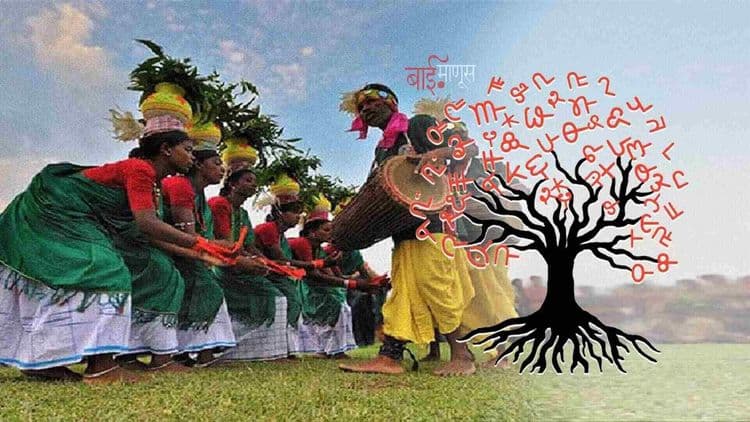
Gond , Bhil, Warli, Pawari, Mawchi, Korku, Kolami, Katkari, Madia etc. dialects are the major dialects in Maharashtra. Although these dialects are important, among them the Gondi and Bhilli dialects are the most ancient. The Gondi dialect is spoken preferentially in Maharashtra and over a large swath of central India. Gondi dialect is also spoken in the districts of Chandrapur, Gadchiroli, Nanded, Amravati, Nagpur, and along the border of Andhra Pradesh. The Gondi dialect is the most widely spoken among the tribal dialects of Maharashtra. Some recent researchers are also providing evidence that the Gondi dialect is a script.
Jules Bloch, a German linguist who closely studied the Gondi dialect, tried to discover the internationality of the Gondi dialect. Caldwell argued that Gondi is the only ancient language to possess the integral features of any of the Dravidian languages.

Considering the state of Maharashtra, most of the people who speak Konkan and Warli do not understand the language. Therefore, as per the experimental examples given above, dialect should be included while teaching tribal children. A child admitted to school from such an area gets confused on the first day. Because he does not know the language of teachers. As a result, there is a greater fear of such children dropping out of the education stream later, and it is also observed that they do.
The reason for this is the only dialect barrier. To remove this gap with education, now it has been decided to give education to tribals in their own language. For this, the process of development of educational materials has been started by experts working in this field, but it needs to have broad government support. Apart from this, government will is also important.
Gadchiroli is known as a tribal-dominated district in the state. The local dialects are “Gondi” and “Madiya”. A separate Tribal Development Department works to bring tribals into the mainstream of development. The government is now thinking of imparting education in Gondi and Madiya languages in the ashram schools of the Gadchiroli project, but one of the schools running in the 'Gondi' language here has been declared unauthorized by the government. So is the government's will to bring tribals into the mainstream? A question mark remains on this.
This school is located at Mohgaon in Dhanora Taluka of Gadchiroli District. One day the gram sabha here decided to start a school imparting education in the Gondi language by using the constitutional rights given to it and accordingly started such a school. The name of the school is 'Traditional Koya Jnanbodh Sanskar Gotul'. This school has been started under the powers vested in the Gram Sabha under the provisions of Articles 244 (1), 350 (c), and 13 (3) (c) of the Fifth Schedule of the Constitution of India. This is a residential school. Currently, 65 students study in this school.
Four teachers, including the headmaster, teach various subjects in this school, including the Gondi language. Agriculture and nature conservation are taught here along with the regular curriculum. This school has become a name in the taluka as a center for imparting Gotul's traditional rites and education. The dialect of any group is the medium of telling their tradition and history. It is an integral part of the culture of that group. The dialects of many groups have disappeared in the dark. Therefore, this effort made by the Gond tribal community to preserve the existence of the Gondi language and to convey the language to the next generation is noteworthy.
Another important issue is whether teachers in Zilla Parishad schools in Maharashtra are sensitive to tribal language. Also, if a teacher educated in the Beed district, who speaks the local language, joins a school in the remote areas of Nashik, Palghar , how can he teach the children in the local language? A teacher says about this, "There are very few teachers in tribal areas." A teacher from any part of the state can be transferred anywhere, resulting in a language barrier.
The education department should respect linguistic diversity. While a total of 47 languages are spoken, there is no teacher training that integrates linguistic diversity and the language of formal education. How can a teacher from Marathwada go to the remote areas of Nashik and teach the children in the local language? In the year 2015, the first book in Marathi contained the poem 'Dhond Dhond Pani De'. She spoke of tribal language and connection with the soil.
This poem was removed from the textbook. I was requesting the then-minister. But in vain! It is written in the curriculum committee to respect the language of children till the third grade and bring them to standard language in the stream of formal education. Balbharati and SCERT, the two curriculum-related institutes in India are only in our state. Yet we are lagging behind in terms of tribal dialects and its relation to education.”
At the local level children speak, it is the vernacular, the local language. In this regard, the issue of increasing the linguistic sensitivity of teachers has been neglected. Adivasi children and parents do not feel close to the standard language. Their emotional world, their culture, language, world of experience does not come within the scope of formal education.
If we want to work with those people, we should first work on the language, we should learn their language, and the teachers and the government should keep in mind that. Otherwise, the linguistic gap remains. Children do not feel close to teachers, schools, formal education process. They don't want to come to school. They beat the school. These children don't have to tell the government why they don't want to go to school. They drop out of school later. The statistics of 'dropout' of tribal children were published. Everyone laughs. But what is at the root of it is not taken into account.
Often at state or district level teacher meetings are conducted offline and training is conducted online. Training and even the local language is such an important issue that it should be offline. But it is not noticed. As a result, when a teacher from Beed, Osmanabad goes to Thane district, he does not even know the language, nor is he sensitive to it, and he works as a boarder. Children turn their backs on education and then look to wage labor like their parents. A vicious circle is complete.

Keeping in mind that most of the tribal students are turning away from education due to the language barrier, the process of developing educational materials for students and teachers of class 1st to class 8th in tribal dialect was started in 2015 by the school education department. Maharashtra State Educational Research and Training Council has been entrusted with the responsibility of including Korku, Bhili, Mawchi, Pawari, Gond, Warli, Katkari, and Nahali tribal languages in the school material. The current state government's policy is to educate children through dialect.
The rulers announce their intention to implement the 'Kerala pattern' in the state's education. In Kerala, Gram Panchayats have the authority to run primary schools while Zilla Parishad has the authority to run secondary schools. Be it the Hiwali village in Trimbakeshwar, Jeevanshala in Nandubar, or the school in Mohgaon, all these experimental models should be implemented everywhere. In addition, society and the government should first welcome this school experiment started spontaneously by the Mohgaon Gram Sabha.
The school should complete the necessary technical matters as per government rules. Without doing anything like that, asking to close the school after three years on the issue of technicality, and imposing a fine of lakhs on the management for providing education, is the government's inclination towards the language, culture, and education of the tribals? Such a question seems to arise.
Figures on education from the Union Budget 2018-19 to 2022-23 are shown. Accordingly, the total investment in education for 2022-23 is 1.04 lakh crore. This year's provision is 16 thousand crore more than the provision in the revised budget for 2021-22. The provision for school and higher education in this budget is 63 thousand 449 crores and 40 thousand 828 crores respectively. Although there is an increase in education provision from 2018-19 to 2021-22, it is deceptive.
The provision for education in the total budget expenditure was 3.54 percent in 2018-19. It will be 2.64 percent in 2022-23. The provision for education expenditure is 0.41 percent of national income. That is, it seems to be decreasing. This provision has been made for mainstream education. However, there is still a lack of micro-planning of what provision has been made for tribals and for education in their dialect. While this is the state of education at the government level on one side, on the other side, the assets of billionaires have increased from 23.14 lakh crore rupees to 53.16 lakh crore rupees between March 2020 and November 2021.
From the wealth of the first 10 people, all children in India will have an unhindered education from kindergarten to higher education for the next 25 years. If a one percent wealth tax is levied on this super-rich 10 percent population, the government will get an additional revenue of Rs 8.7 lakh crore annually. This will provide additional funds for education and health, but instead of doing so in this year's budget, this tax has also been reduced. Doesn't this explain the government policy?
If the survival of the tribal society as a whole is to be maintained, then their language should also be preserved. It also requires a special plan and program of action. If their languages become the language of knowledge, the tribals will come into the mainstream of education. In the future, the literature that presents the reality of the tribals' lives and gives a glimpse of their culture will also take shape from it. Not only will their dialects become richer, but our multilingual, multicultural country will also become richer and stronger in terms of languages.