There are many human groups in the world who are constantly striving to transcend all the limitations of caste, religion, creed, region and come closer to human existence as human beings. But as the unjust sharp edges of discrimination are sharpened again and again by the ruthless ambitions of racial supremacy, caste and religious supremacy, the song of human interest has been drowned out all over the world. The first victims of all these were the nomads, gypsies and barrens from all over the world. This wandering group. In fact, as the saying goes, 'This world is my home', considering the earth as the mother and the sky as the father, these travelers who tried to cultivate the relationship of universal solidarity in the whole world, accepted the environment of the country and the environment they entered, and faced it with a smile. He did not consider any religion, creed, country, region, profession or language taboo.
Because basically they were avaranas without religion, out of color. Yet Hindu tribals, nomadic Banjaras in India, Muslim Banjaras in Arab-Muslim countries and Christian Gypsies in western countries indulged in religious faith. But due to their not being fully accepted by the religious people from history till today, a mixed language, mixed system culture was born all over the world due to continuous wandering. It is known as Banjare Nomad in India and Asia, and Gypsy in the world.
Gypsy, Banjara, Bhatke, Nomads are the trending concepts, but we have reflected them into caste and tribe. The same group reached from India through Rajasthan, Sindh, Punjab, etc. through the Hindu Kush Mountains, through the Caspian Sea, from Iran, Turkey, Macedonia, Greece, Romania to Spain, America, where the people of Indian tribes such as Banjare, Dom, Dombari, Sikalgar, Lohar, Gurjar, Sansi etc. Ancient traders like Banjaras, artistic tribes with a livelihood of art, artisans, handicraftsmen, warrior tribes continued to leave India in different periods and for various reasons from BC to and 14th century. The Banjaras, who had been trading since pre-Buddhist times, were taken away by Alexander in 323 BC. Muhammad Ghazni took many as slaves. Despite the increasing invasion of Arabs, Turks, Mongols, etc., and the killing of 30,000 Banjars by Emperor Akbar's army, all these people did not return to their homeland. Later it spread all over the world.
 For thousands of years these people have been living as slaves and laborers.
They live in 50-55 countries from Middle East Asia to Europe, Russia, Sweden, Spain, Britain, Italy, Turkey, France, Greece, Romania, Hungary etc. It has a total of 13 different types of gypsies. They are known by the names Jigener, Saiges, Manus, Tatar, Gitani, Yasimagal, Shingan, Roma, Romani, Lomani, Domarin, Lomvaren etc. But like the Indian Banjars, they identify themselves as Roma or Gypsies. Early artists, artists, lovers of dance, song and music, sculptors, weapon makers, obedient soldiers were treated with respect, but due to the struggle for supremacy that started in the world for some centuries, they have to go through a huge deadly struggle. They are being subjected to degrading treatment as third class human beings, thieves, untouchables. They are becoming the victims of the fury of apartheid. Many countries are not ready to accept them as citizens.
They don't give house, job, work. Orphanage is their lot. During World War II, millions of Gypsies were killed by Hitler's Nazi forces. It is imperative to salute their stubbornness and struggle to keep their identity and their peculiar uniqueness intact despite suffering injustice and oppression.
It has been proven many times by Indian and Romani Gypsy writers, scholars, researchers that Gypsies reached the world from India. In which Dr. Kosnovsky, Dr. Ian Hancock 'The Gypsies forgotten children of Indian', 'On Romani Origins and Identity.' Dr. Ronald Lee 'The Grammar of Lamani' without Dr. S. S. Shashi, Dr. Rajendra Rishi, Ketkar, Dr. The observations of Ganesh Devi etc. in this regard are very important. According to scholars, most of the Gypsies have a striking resemblance to the Indian Banjars in terms of behavior, language, folklore, lifestyle, dance music, dress, jewelry, food etc. Roma, Romani, Lomani, Lowarin are the most numerous Gypsies in linguistic usage today, with hundreds of words, syntactical meanings similar to Laman Banjara.
Roma gypsies who travel in groups sew their colorful clothes with their own hands, just like Banjars. Necklaces of colored beads, money attached to the collars are worn around the neck. They travel in horse carts (buggies) like umni (bullock cart) of Banjars. Spicy meat is their main food. The remarkable similarity in their origins and religious beliefs can be seen from the folk songs.
“Once upon a time the sky and earth, were man and wife. They had five children- sun, moon, fire, cloud and water and between them they created a fine place for their children. They unsuccessfully tried to part the earth and the sky, but failed. The other children tried too, but failed. But one day the wind lunged at them and the earth was separated from the sky.' So the 'Valang' of Lamanas is Prakriti Puja. "Pelo nam surja waro lijo, ratero kiyo dan wajalo, dujo nam chandisaro lijo, chandni rat suwavani, tijo nam dhartira lijo, jalse upje hariya mung, chavatho nam mhare meghjaro lijo, jal barso dandibandaro." Apart from this, numerous folk songs like 'Chandan Suriya Doibhai, Amar Vege Jagemayi' can be heard. Gypsies' cultural symbols include the sun, moon, stars, kavadi and suri, while the Lamans worship kavadi, rupi, suri and goddess effigies. Prayers to the moon, sun and earth are said by taking out a wheel made of flour called chokho.
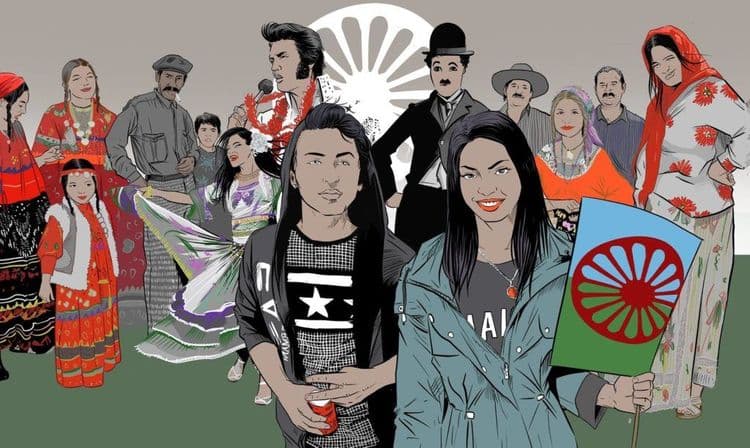
The early history of Gypsies is not very traceable. One thing is evident from this, that the history of the underprivileged is not only forgotten and neglected in India; So this is just a picture of the world. But the history of the underprivileged is engraved on their minds and words on their lips. It cannot be erased by doing anything. He revisited Pablo Picasso, Charlie Chaplin, Dr. August Krogh (Science Nobel), Rock and Roll Emperor Elvis Presley, Tyson Fury (World Champion Boxer), Yul Brynner, Michael Caine, Rita Hayworth (Actor), Ili Natasse (Tennis), Jones Bihari (Violin), Glakeria Kotsula, Reshma ( The life of gypsies has received a boost in the form of thousands of world-famous talents like singers, flamenco, amaya (dancers).
In recent times, the meeting of Roma Gypsies as 'Bichhde Huye Bhai' is being held at the initiative of the Government of India, which is certainly a commendable matter. But, if the similar nomads in India are concerned in the same way, it will indeed be in accordance with the policy. anyway But if the name 'Gypsy' is given to the journey made by determination and struggle to escape from the hardships of the country, time and condition, it will not be very wrong.