Two films that came out a few years ago became hugely popular with the masses. He went home in his mind. We highly appreciate both the films as they cover the Indian environment. One was Nagaraj Manjule'sa walk', and another is based on the writings of Rudyard Kipling's 'The Jungle Book'. Because of these two films in which Chandru Madavi, those who have read or heard this name surely remember Chendru Madavi. There are two reasons for that. One, Mowgli in “The Jungle Book”, and two, his life with Chita, his relationship with wild creatures. It was a fictional story from 1894 but embodied the Indian jungle sensibilities. Another thing is, an anonymous relationship between the boys who became the heroes of the success of 'Sairat' with no experience in the film world, is directly linked to Chendru Madavi, a real tiger boy only eight years old in the jungles of Bastar. Because of these two films, Chendru Madavi did not slip in front of my eyes either, because his life started like a shining star. As befits a bold, adventurous story. And it's end, sad, heart-wrenching.

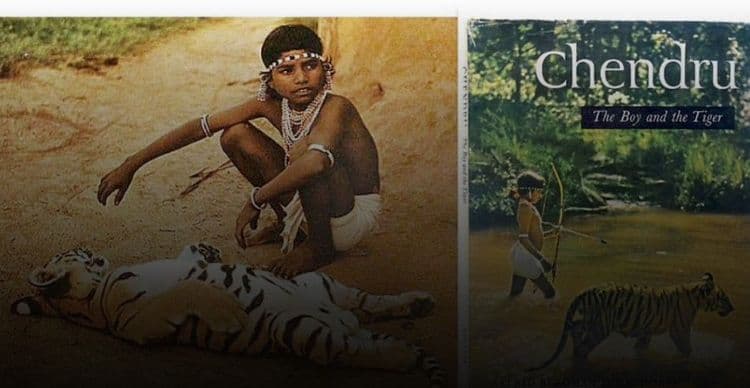
This is generally from 1955 to 1960. All this was happening in the forest of Narayanpur, Chhattisgarh, Abuzmad district of Garh Bengal. Chendru Madavi, who is known worldwide as 'Tiger Boy', is a boy born in the Madia Gond tribe. When he had just learned to walk, his hunter grandfather and father brought him home a tiger cub one day as a toy. Chendru was very happy. He has a dear friend. He named it 'Tembu'. Sitting on this friend's back, Chendru started walking in the forest. With the help of 'Tembu', he and his sister also started playing with the cheetahs in the forest. He used to hunt fish and rabbits to feed the cheetah. His name was so accurate that he hunted fishes, running rabbits in running water with one arrow.
Before the Indians heard about this 'Tiger Boy' playing with tigers and cheetahs in Bastar forest, the Swedish director, Arne Sukdsdruff, looked at him. Saxdruff came to Bastar and teamed up with local technical artists to produce a film in Swedish called 'The Jungle Saga' about the life of Chendru Madavi and his best friend 'Tembu' the tiger. The heroes of this film were, of course, eight-year-old Chendru Madvi and his best friend 'Tembu'. The plot revolves around the life culture of the tribal Madia Gond tribe. Madia tribals and jungle creatures were appearing on film reels. The film was completed in 1957.
In the 1958 Canes Festival,'Chendru and Tembu' did well. Later, in English, the Flute and the Arrow' Adapted, the plot of this couple made its name at the 1960 Oscars. Won many prestigious awards. Chendru reached its peak of fame in the western nations with this one and a half hour film. People started flocking to see, touch and take pictures of this 'Tiger Boy'. Chendru traveled to Sweden and other countries for one and a half to two years. Around the same time, in the 1960s, Astrid Sudruff's book titled 'Chendru the Boy and the Tiger' was on the bestseller list.

This period was like a dream for Chendru. During this period, Mahebub Khan's 'Mother India'(1958) was nominated for an Oscar. It was talked about all over India. Obviously, it was the first film from India to go to the Oscars. But except for the language and the director, the story, the entire cast, the lyrics, the music is all Indian (Pt. Ravi Shankar composed the music for this film), and even though it won the prestigious Oscar, nothing was said about the film, about the powerful acting, about the real life hero. Not gone, not much written or remembered.
The then Prime Minister Chacha Nehru, seeing the fame of 'Tiger Boy' Chendru spread across Europe, dared to invite him to Mumbai. He also met them. Chacha Nehru said, 'Padne ke baad kuch de dunga'. However, the father did not teach further. How will the tribals living half-naked, hunting and eating know the importance of education? After returning from Sweden, many dreams were blooming in Chendru's mind. There was a strong desire to learn. He had seen the difference between the two countries. Chendru, who had returned from Sutabuta, wanted to be replaced. On this occasion, a question also sneaks into the mind that if Chendru's quality, courage and intelligence had been facilitated by the government level, perhaps Chendru would still have raised the name of the country. But circumstances did not allow it.

Once again, a dark shadow fell on the life of this hero who worked for two rupees a day. Chendru got lost in the forest of Bastar. 'Tembu' also died. The moon broke even more. He found a mate for life by living in Gotul as per the custom of Madiyas. He continued to live a normal life with daily labor and physical hardships. He gets upset when he remembers the past. Used to cry He After almost 40 years, in 1996, the people of Gadbangla got to see 'The Jungle Saga' for the first time. Pramod Mathur and Nilima Mathur because of Chendru, however, did not see him and ran away into the forest. Pramod Mathur made a documentary on Chendru's life called 'Jungle Dream' (1997). This was the only response any Indian gave to Chendru.
This 'Tiger Boy', who introduced Bastar and Madia Gonda to the world, suffered a stroke of paralysis. He lay ill for several days. There is no money left for treatment. On social media, Yashwant Ramtek This friend appealed for help. But no Indian hand came forward. But Tokyo (Japan)Throw Emmanuil1.17 lakhs helped. Finally, the 70-year-old Tiger Boy died on September 18, 2013, due to illness. Chendru's fate was rarely the same as the newspaper news when a special person passed away in our idealistic society. The tragedies of real life heroes like 'Mountainman' Dashrath Manjhi, 'Golden Runner' Pansingh Tomar, 'Bandit Queen' Phulan Devi, 'Natrang' Ganpat Patil, 'Tiger Boy' Chendru Madavi, have remained in the film world only to gather capital.

Rudyard Kipling's fictional story Mowgli was brought into homes and hearts by the Indian media. But our country never got to know the real 'Tiger Boy'. It is a shame that the tribal barbarians living in the valleys gave birth to violent, venomous creatures and that the 'so-called' advanced people we learned could not give birth to the savages. Today, there is more need to see and behave like compatriots, compatriots, than to see them as 'forest dwellers'. If we search for intellectuals, meritorious, skilled people, just as we search for minerals in Bastar or other tribal forest hills. Mahendra Singh Dhoni, Everest GirlPoorna Malavat, the gold medalist of hockeyJaspal Singh Munda, DreamrunnerBudhia Singh, Pansingh Tomar, Mountain Mandashrath manjhi, the tree manJadav Payeng Molai, Sabarpada ExpressKavita Raut, Dilip TirkeyThe mining of such numerous diamonds and pearls will not be done by hand.