The world has heard the love story of Ajintha's Paru for more than 150 years. This love story in the real sense broke all the boundaries of Indian society and crossed all the boundaries of country, region, caste, religion, society, culture, language etc. and showed society that love cannot be bound by any boundaries. This message seems to have been engraved on Ajanta's immortal skin. It will be considered as a symbol of pure love for thousands of generations to come. The Indian society, psyche of discrimination, named this love story tells it in a distorted way, but the reality of this story is as clear as a spring. Sparkling like a diamond, Pak is like a prayer.
As Ajanta's researcher unfolds the saga of the sculpture, one story draws extraordinary attention. That story is the love story of Robert Gill and Paru. It stands as a living sculpture in Ajantha's sculptural array. Amar has passed away. Ajanta is not complete without experiencing or knowing it. Moreover, no matter how old this love story is, as long as Ajantha is there, this story will surely flow, so much essence was and will remain in this love. There is no excuse. This true love story has become unfulfilled.
Rangavali, a gem of medieval sculptures in the Indhyandri branch of the Satmala mountain ranges of the Sahyadri mountains, opened its doors after a thousand years of samadhi. Perhaps the Yaksha Gandharvas, frozen in this black rock, wanted to chant the Saptasuras with a free throat. The Apsaras wanted to beautify themselves with their dancing skills. It was to bring together two faraway birds in the lap of Ajanta's world-renowned artistic beauty.

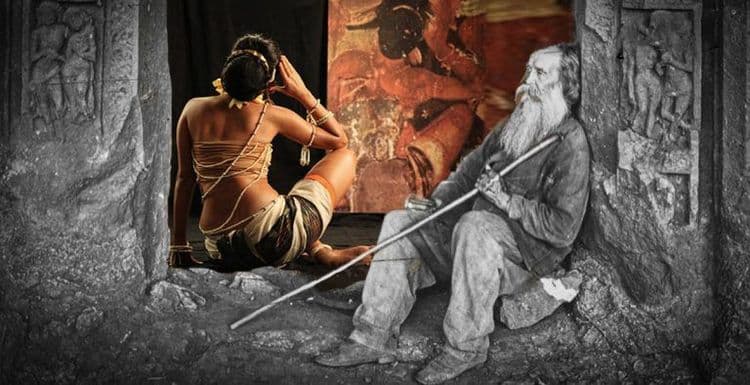
The love story of Major Robert Gill and Paru, which took shape in the short ten-twelve years of 1844 to 1856 in the semicircular basin of the Waghur River, which captures the heart of every human lover, is the union of the different religions of two directions, two countries, two cultures, two minds, two languages and all the differences. To live apart is to live as one. This should be a parable on the path of human existence. A Western art lover, the thought of humanity and an Eastern ajagar irreligious caste, religion, varna external culture cave. This rainbow love story should be mixed with just living. One of the many Jataka stories depicted in Ajantha is Robert and Paru, who are about to become 'premjataka'.
Amazed by the paintings in the caves, Major Robert Gill did not know when he involved himself with the paintings and the 17-18-year-old tribal Laman Parut. And his brush began to paint the colors of love. Paru was extremely handsome, tall, talented, celebratory, skilled at adding color to songs and dances. One of the laborers working in the caves in Laman Tandya, a tribal is who nurtures the heritage of performing arts such as dance, song etc. There is a lot of evidence of Robert Gill falling in love with Paru. Suddenly the story took a tragic turn. Paru died of plague on 23 May 1856. Completely isolated, Gill erected a memorial to Paroo in Ajantha village with the inscription “To the Memory of My beloved Paroo.'
After almost 500 years, many writers, poets and artists saw this true story. Some tried to organize based on research, some on hearsay and some on hypothetical reasoning. Instead of clarifying Paru's identity, it became more gray and distorted. At the same time, when history or historical events are transformed into art in our society, it is not taken very seriously like in the West. We have seen many times when history is broken at such times.
Since Robert Gill was a world-class painter, many people have researched and written about it, but unfortunately, no one has explored Paru's psychology or history and geography beyond just a lover. Indian Mistress, Tribal Girl Paroo is mentioned only in British records of Madras Native Infantry and in the article 'A Colorful Father' by Robert Gill's son, Williams Gill, and in the records of Gill's great-great-grandchildren. Beyond that, they are all found in Ajantha's Panchkroshi. From the few surviving remains, from references buried in soil, to folklore preserved for hundreds of years by oral tradition. Sometimes this has to be considered as a norm. Because Paru's identity is clear in the context of Indian society. But looking at the social environment of Paru, she belongs to the deprived and neglected group and in that she is still a woman, i.e. more neglected than neglected and the step taken by her in that situation was a crime. Some people ignored her as belonging to a certain caste, but for those who were interested in the caste, she cut off her nose. British hegemonic history did not place her beyond Mistress Concubine.

Indian caste, religion, caste are based on male supremacy in terms of history where women's achievements are denied. Who will record the history of this tribal Laman Pori, where illusions are created in the history of the underprivileged? In the established society, Paru has been completely neglected in art, history and literature Moreover, unfortunately, the creator also neglected her in terms of motherhood. If not, her heirs would have continued to tell her reality like the story in 'Kalpadrumachi Dahli' by Gadmal Mali. But the weave of woman's pain in history is kept alive by woman's lips. Paru is kept alive and young by such beautiful female songs. Day by day, folk culture and folk songs are dying. Even the generation that nurtures this tradition is becoming extinct. This history of Paru, which is glorious on the screen, may become a mere legend tomorrow. Future generations will regard Robert as history and Paru only as an idea whose existence we have dimmed and distorted.
We have lost countless pages of history that have the perfect inspiration of sacrifice, like Paru, symbols of love and sacrifice.