Poverty, malnutrition, infant mortality, superstitions, undesirable customs and traditions... even in the lives of tribal brothers who have been living a miserable life for years, they forget the pain and see some happy moments. Bohada is one such joyous festival that takes place on the tribal padas in Thane district after the full moon of Holi.
Tribal brothers have their own way of life. Their traditions, customs, deities are also different. In the same tradition, the Bohada festival has a special place in the religious life of the tribals. The fear that if Bohada is not done, the wrath of God will be unleashed, the pada will be destroyed, food grains will not grow, and people will die due to lack of water, has been inculcated in the minds of every tribal from childhood. Therefore, every tribal brother is seen participating in this festival with devotion. As the month of Chaitra approaches, there is not much work left in the fields and forests. Tribals are free. It is then that the purpose of celebrating Bohada is entertainment as well as religious spirit. Ooroos and fairs in the villages are also celebrated during this time, while the tribals of the remote padas also get colorful in their village festivals.

Bohada is a dance of masks
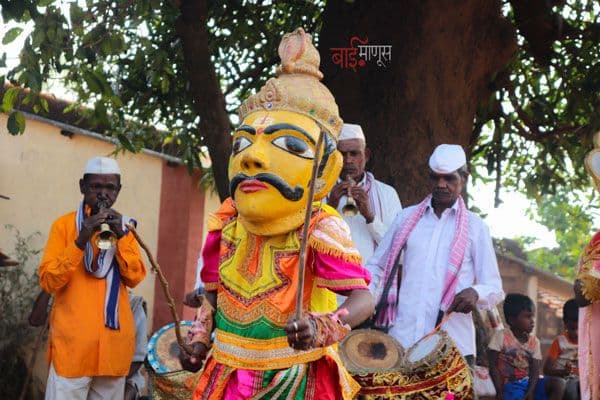
Bohada is a dance of masks. Bohad means masked Songe, but it is not Songe but Swa +ang, Swang. Actors impersonate themselves as personalities. The Bohada dance tradition has been cultivated for the past two hundred years. It is known as the festival of tribals. It is celebrated in the village on the occasion of the village deity. At that time, a procession of gods and goddesses is taken out of the village. Bhovanda gives. Bhwanda – Bhwada – Bhwada – Bohada. It is mainly celebrated by Mahadev Koli, Bhil, Kokana, Thakur, Warli, Katkari, Dongarkoli etc. communities of Thane, Nashik, Ahmednagar districts of Maharashtra. People are empty during Chaitra-Vaisakh. Minor work in the forest and fields are over. A new season, a new rain is in a month or two. A farmer has a free day. Bohada paints on those free days. Utsav and Ooroos are celebrated in every village. At such a time, Bohadya begins after worshiping the village deity. House-to-house subscriptions ranging from five rupees to twenty rupees are collected from the villages.
In the bohad, vows and honors are fixed. If it is decided to start a new Songa in Bohady, it is done with honor and ritual. Artists of those strong people with hard-earned physique forget their body consciousness and dance with devotion and faith in the festival. The artists wore the masks of Gods, that God is infused in their body! Artists forget their body consciousness and dance with masks. Although bohada is considered a form of entertainment, it has an important place in the lives of tribes. It is the ritual of his spiritual life. If it is not done, they think that there will be problems with their pad, rain water will not come, crops will not grow, pada will disappear. That is why they have a religious feeling that they must celebrate 'Bohada' for the safety of the village. Dress is of little importance in Bohad. Some have their own costumes. Some people bring robes, fetas, maces, swords, lehengas, chalas, ghungru etc. from the city for rent. But it is not that one thing hinders the dancing of Songe. So Songe danced in regular clothes as well. In fact, the artist had assumed the guise of Nrisimha; but he had entered the stage wearing a loincloth!

Masks of 150 years ago
It is understood on the occasion of Bohada that, just like the tradition of masks in the world, it is also rooted in tribal. It is said to be the original dance art of tribal society. Tribals wear different masks on every occasion, like religious festivals, entertainment programs, customs and traditions. However, the amount of masked play that takes place in Bohada is rarely seen on other occasions. All the masked characters are male. Women do not participate in it. Different songs are danced in this festival. When tribals had no contact with rural and urban areas, wild animal songs were danced with their masks. For the last one and a half to two hundred years, the masks of Hindu Gods and Goddesses have entered the Bohadiya. The mask of Ravana and Mahishasura weighs 30 kg. Mahishasura has to dance wearing a red mask weighing 20 kg. The energy of the tribals dancing these masks for four hours is admirable. Some masks are even 100–150 years old. They are painted every year. So, as earlier wooden masks became difficult to make and mirror, they have been replaced by paper and cardboard masks. Vehicles like rats, peacock, Nandi, horse etc. are prepared for the deities. Drawing different expressions on the masks of gods and demons is also an art. So, even the artisans who make the masks have respect for the Padas.
Young people have to take an exam for Bohada
Bohada is three days, five days, seven days. Some swords are vows. In some places, there are two or two swords on the same pada. At least twenty-five to thirty artists participate in a bohad. In Bohada, it begins with Thape. Thap means dipping all the five fingers of the hand in the hingul and making an impression on the wall of the temple along with the paw. a small bohada of three days and a big bohada of five and seven days! Important Mhasoba, Rakshasa, Devi (Jagdamba) songs are not danced in the small Bohad. Those songs are danced in a big onboard. Goddess Pooja is performed on Tuesdays or Fridays in Bohada. That is, if there is a five-day Bohada, that begins on Friday and ends on Tuesday, while if it is a seven-day Bohada, it starts on Saturday and ends on Friday. Various songs are danced for four and six days. On the last day, i.e. Friday, Songe leaves with Mhasoba and Devi.

A few days before the main event begins, the village elders scrutinize the newcomers who work in the bohad especially looking at their preparation for dancing. A dancer playing the role of Mahadev needs to be able to dance like Nandi and a dancer like Saraswati like a peacock for hours without getting tired. Not only that, that not also has to handle the cry of that animal. Only those who meet these criteria can participate in the program. On the actual Bohada day, a long strip of road is laid out to spread the nuts. Spectators sit thickly on both sides of this road. At night, palitas are lit and the game of Bohadya begins in their light. First, the moderator bows. Then the clown starts jumping to the beat of sambal and pipanya. Then the spearmen and choppers herald the arrival of Lord Ganesha, followed by Lord Ganesha mounted on a rat. Ganapati is gone, Saraswati comes and goes back dancing and blessing. After this, the main plot of Bohadya begins, and it runs for five nights in a row. People also watch it without getting bored or tired. Two to two hundred nuts take part in it at a time.
The congregation that participates in Bohada fasts on the day on which the mask is to be worn. It has been carried on in that family by Songe tradition. Each song has different playing contracts. Song changes, that contract changes. In such a way, until the early hours of the morning, the Songas wearing different types of masks come. As the first rays of the sun fall, a person in the form of a goddess (all the masked characters are men. Women do not take part.) enter the temple of Ambe. Devotees worship her. After the pooja is over, the goddess comes out. On reaching Mandapat (Chandani), she meets the character Mhasoba (Mahishasur). At that time, the goddess 'fights' and kills Mhasoba. Devotees standing around with coconuts in their hands break the coconuts. Then the goddess comes and sits in the 'Chandni', the congregation takes their vows, while some say new vows. The ritual continues till noon. Later, people go to their homes and come back to watch the wrestling matches in the evening. A fair is held on the occasion of Bohadya. The tribals enjoy some fun, shopping for the kids and some sweets on the occasion. Bohadya's fame has spread beyond Maharashtra in the last few years. Therefore, fans from all over the country enter Mokhada to watch this tribal festival. It would not be an exaggeration to say that this festival, which showcases the culture of the tribals, touches upon the harsh reality of the tribal padas.