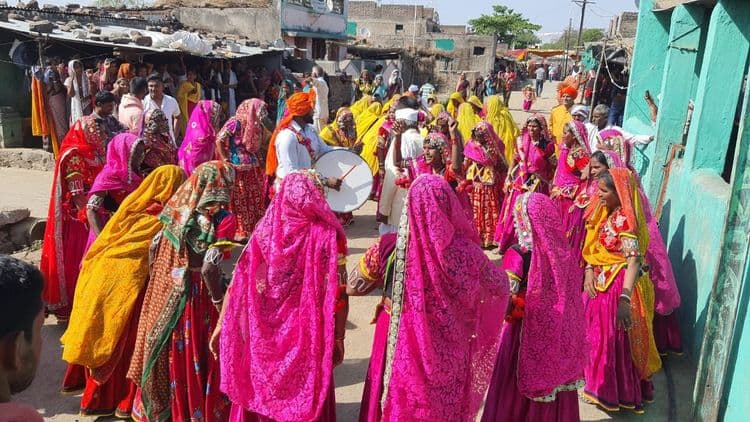
When the orange color of Kesula starts to bloom in the forest, then slowly the Tanda also starts to bloom. The scattered people for sustenance throughout the year once again start running towards the tree when Holi starts. Tanda wakes up. The scraps of the houses start to decorate. White pots of white clay are rolled from the walls. The land is made green by adding dung. Moha flowers are drenched in heat and humidity, and their pungent fragrance begins to overpower the tree. After eating early in the evening, all the men and women of the family gather together and start singing Holi songs.
AAVO BHAI DIE SANLEKHELA RAM HOLI
HOLI RAMLO RAMBHAI HOLI RAMLO RAM.
Before Holi, month by dancing starts. Gor Banjara Gana is already a dance and song favorite. In it, Holi said that their enthusiasm would have only risen. Banjara's Holi is not just a one-day festival. It is their cultural festival. There is a big difference between the Holi of Hindus and the Holi of Gor Banjars. The year of Gore Banjaras begins with the festival of Holi. All their transactions are done on Holi contracts. A ritual called 'Dhund' is performed on the day of Holi for children born in Tanda before Holi. Looking at the nature of Holi and the folklore of the Banjara community, Vedic Hindu Aryas and Holi have no connection other than Agni Puja. In Nagar Hindu society there is a tradition of lighting Holi on the night of the full moon in the month of Phalgun. But the Gor Banjares only celebrate Holi that night. Holi is lit before sunrise the next morning. The song is sung while lighting Holi

VARA RE NAGASWAMIPENA VAHITE DUNGAR KHOLANOW I HAVE COME TO TANDEMA HEREWHEN I WAS A MOUNTAIN. I WAS FAR AWAYNOW I RECOGNIZE YOU
The Banjaras consider themselves to be of Naga descent. It is felt from the above song that this society, which was scattered in the jungles, valleys and valleys, came together and the joy of their coming together came to be celebrated on this day of Holi. It is customary to bless Holi Petli or the hero of Tandya with songs. It is also called 'Vajana Deno'.
During Holi, men are called 'Geriya' and women are called 'Gerani'. Then the Gerani and Geriya of the Tandya bless the hero of the Tandya with this song. We have landed in Geriya Nayak's courtyard and are standing with a flag raised. “Be a hero, bless twenty-five rupees. Measure and measure, but give only twenty-five rupees. May Holi Mata bless you. Bless you Nanakji!” It is said that Holi begins with prayers to God and ends with Lengi Geet. It would not be wrong to say that Lengi Geet is the soul of the Holi festival. And the lengi songs arise from the dhund ritual. The Dhund ritual is not complete without Moha liquor and goat meat. The pairing of liquor and meat becomes a disguised romance of Lengi Geeta, and then the haze of Dhund grows more and more. This length is of two types. First is lengi 'Betir lengi'. It is said to be just sitting on the beat of the duff, cymbal.

Another type of lengi is 'hubir lengi'. It is danced and sung to the beat of a tambourine, a cymbal. Holi is probably called Hubir Lengi when dancing to the rhythm of Halgi. This length has its own accent. It has its own tunes and rhythms. Neither any classical singer nor any musician knows it. Lengi dance also has a different style. The hand movements that Banjara women do while holding hands are simply amazing. They never miss a deal. This dance also has two groups. The first group starts the length song and the second group sings the lines. Often, Lengi's kalgitura runs between Gerani and Geria. Nothing is considered obscene in it. Swear words are used indiscriminately. All dance freely without discrimination of men and women, young and old. The authentic zing of life is expressed through this song.
"CHAROLI PATERI GERNI, FEATHER SHIDAI'SFEATHER FRINGE IS WORN RUSSIA, MOTHER'S NECKBROTHER NAKRA KATAK MARU CHAKRA BROTHER NAKRA'S NECKIS OF BLACK Color SHEEDAI'S BLACK SILKMANDAV BASARI RUSSIABROTHER NAKRA KATAK MARU CHAKRA BROTHER NAKRA'SBLACK AND YELLOW Colored FAIR PANBDI SHIDAI'SBLACK SHAWL IS WORN RUSSIAMOTHER, LOOK AT THE CURLS KATAK NAKRAMARU CHAKRA BROTHER NAKRA'S NECK"
Gerani is wearing a charcoal colored lehenga. The lehenga has a beautiful fringe from the bottom. How much am I going to look at those nails? This sharp-nosed girani sews a tight bodice that reveals her perky breasts, but to hide them she wears an ornament called a mandava. Also, she is wearing a black and yellow colored pambadi. A ghungat is attached to that pambadi with various designs. That carving is catching my attention. How many times will I turn around to see her flirtatious appearance? This is the meaning of this song.
As this kalgitura becomes more and more colorful, the haze of Lengi increases till dawn. Then, sometime in the morning, Geriya and Gerani run away tired and go to their respective homes. This ceremony lasts for two or four days. Once Holi is over, the walls start to crack. Tanda becomes depressed and depressed. A thousand legs again sprout from the trunk. The people of Tanda, tied to their stomachs and backs, go away again for a year only to come again, the next Holi.