There have been many revolutions in the history of India, but the history of Dalits and tribals has either been suppressed or distorted by casteist-minded historians. There have been many brave freedom fighters who did not even find a place in the history books. In Barakpur in 1857, Mangal Pandey's roar spread the fire of revolution across the country. 1857 is said to be the first rebellion against the British. It is recorded in many history books as the first uprising of independence. Mangal Pandey was court-martialed and hanged on 8 April 1857, and historians have declared him the first martyr of India's freedom struggle. But even before Mangal Pandey, the flame of revolution was kindled in various parts of the country and many freedom fighters blew the trumpet of rebellion.
One of them is tribal revolutionary Tilka Manjhi. The first uprising of independence began under his leadership in 1770, 90 years before the revolution of 1857. Today is the birthday of the tribal revolutionary Tilka Manjhi, who started this rebellion.
Who is Tilka Manjhi?
Born into a Santhal family on 11 February 1750 in Tilakpur village in Sultanganj, Bihar, Tilka Manjhi did not find a place in history due to the casteist mentality of Indian historians. Tilaka Manjhi did not start a war against the British because of cow fat or to hurt any religious sentiments. He waged a war against injustice and slavery. Tilka Manjhi used to address local people in meetings in Bhagalpur to awaken national sentiment. Rising above caste and religion, he appealed to people to unite for the nation.
Tilka Manjhi had witnessed the oppression of British rule on his family and caste since his teenage years. Seeing this oppression, a fire would spread in his body like a volcano and a wave of rebellion would arise in his mind to fight against British power. The English rulers had rights over the land, agriculture and forest trees of the poor tribals. The British used to oppress the forest, tribal children, women, old people in many ways.

Message on pages
Tilaka tried to unite other tribal communities. They wrote messages on bark leaves and sent them to other communities. Because of this, many people in the community rushed forward to defend their soil and Tilaka Manjhi got the support of many Sardars. Hill tribes ruled the hilly regions of tribals. The hill chieftains who settled there also fought against the British government to protect their land and agriculture. The zamindars around the hills were courting the British government out of greed for money. Tribal and hill chieftains periodically fought English power, and the hill homeowner class openly supported British rule. Tilka Manjhi fought many battles against the British on the hill of Rajmahal. During the famine of 1770, the Santhals led by Tilka Manjhi looted the government treasury and distributed it among the poor, so the poor people were influenced by Tilka Manjhi and joined him. After that, Tilaka Manjhi intensified his attacks on the British and Saranjamdars (homeowners) and in this he also beat Tilaka a victory.
It mobilized and inspired people.
By 1770, Tilka Manjhi was fully prepared to fight the British. He used to inspire people not to bow down to the British. Get out of the shackles of caste and take away your rights from the British, his message used to be. Finally, the day came when Tilka Manjhi called for open rebellion against the British from the place of 'Banaichari Jor'. Under the leadership of Veer Tilka Manjhi, the rebellious steps of tribal heroes were moving towards Bhagalpur, Sultanpur and the distant forest areas. The hill chiefs were fighting the British soldiers on the palace grounds. Taking stock of the situation, the British appointed Cleveland as a magistrate and sent him to the palace. Cleveland looked around with his army and police.
Tilka Manjhi took his army to the jungle, terai and valleys of rivers like the Ganges, Brahmi etc. and secretly fought in the hilly areas of Munger, Bhagalpur, Santhal Parganas, constantly fighting with the British military officers. Govt. Veer Tilak fought fiercely against the forces of Clive Land and Sir Eyre Coote in many places. They started towards Bhagalpur, fighting the British soldiers. From there, his soldiers secretly started attacking the British army with weapons. Given time, Tilaka Manjhi climbed a palm tree on 13 January 1784. At the same time, Cleveland arrived on horseback and Tilaka Manjhi killed him with poisoned arrows. On hearing the news of Cleveland's death, a wave of panic spread through the British army. It was a great success for Tilka Manjhi and his colleagues.
While Tilka Manjhi and his companions were celebrating this victory, the British general Ayrkut attacked in the dark of night, but Tilka Manjhi escaped and continued to attack the British by taking shelter on the hill of Rajmahal. Failing to capture Tilka Manjhi, the British besieged the mountain and stopped all aid reaching Tilka Manjhi. Due to lack of food and water, Tilka Manjhi had to fight his way through the mountains and was captured one day.
Mangal Pandey, India's supposed first martyr, was not even born when Tilka Manjhi was hanged. Although Tilka Manjhi's contribution is not mentioned in our history due to caste-minded historians, many writers and historians have given him the distinction of 'first freedom fighter'. The great writer Mahasweta Devi wrote a novel in the Bengali language, 'Shalgirar Dake', on the life and rebellion of Tilka Manjhi. Another Hindi novelist, Rakesh Kumar Singh, has narrated the struggle of Tilka Manjhi in his novel 'Hul Paharia'.

There is a long list of Dalit and tribal heroes and heroines in India, but not remembering the Dalit and tribal heroes and heroines of India's freedom struggle as martyrs is highly biased and shameful. The way Dalit-tribal heroes were executed, hardly anyone can feel the pain. But even in that sorrow, there was the joy of freedom. Historians may have overlooked the movement and sacrifice of tribal hero Tilka Manjhi in this case, but Rajmahal's tribals still sing folk songs in his memory, recounting stories of his courage. Tilka Manjhi is alive in his heart. Tilaka Manjhi is remembered in various forms in many songs and poems-
YOU WERE SHOWERED WITH WHIPS.YOU WERE TIED TO HORSES AND DRAGGED, BUT STILL YOU COULD NOT BE KILLED. YOU WERE PUBLICLY HANGEDIN BHAGALPUR, BUT THE HOMEOWNERS AND THE BRITISH REMAINED AFRAID OF YOUR TILKA (ANGRY) EYES, EVEN AFTER DYING YOU COULD NOT BE KILLED, YOU WERE NOT TILKA MANJHI MANGAL PANDEY, YOU WERE THE FIRST REBEL OF MODERN INDIA
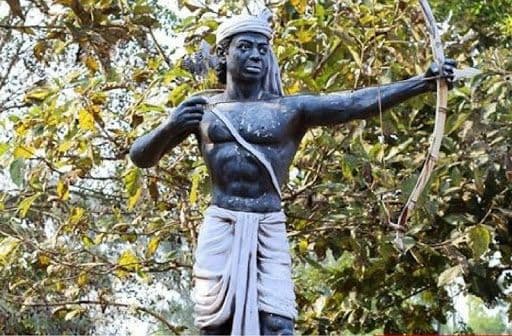
Tilka Manjhi's name may not go down in history, but his name has een remembered in Bhagalpur district of Bihar for the past two centuries. In 1991, the Bihar government renamed Bhagalpur University as Tilka Manjhi University in his honor. Along with this, a memorial was built at the same place where he was hanged.