Rather than face-to-face discussion on the problems of tribals, how can they solve their survival and existence problems, how can a concrete action plan be implemented for this, how can the problems of tribals be addressed from the root, recently SM of Pune. A two-day brainstorming and workshop was organized by the 'Arohan' organization at the Joshi Socialist Foundation. A number of scholars working on tribal issues participated in the workshop on 'Tribal Groups in Maharashtra: Health and Education'. Malnutrition is a major problem in tribal areas. In that regard, how can we come together to overcome malnutrition? How can health communication be done with them? This was discussed. There was also a discussion on education in tribal areas, the poor condition of ashram schools there, and what the new education policy says.
A Study of Community Efforts to Overcome Malnutrition
Speaking on the issue of malnutrition, Shailesh Dikhle said that since 1975, the 'Integrated Child Development Programme' has been implemented in India for malnutrition. Malnourished children were initially at the center of the programme. But now the severity of malnutrition depends on the health of women and their position in society. Everyone started to understand this gradually. Therefore, measures regarding women started coming in this program. Initially, special health schemes were implemented for women. Focus started on pregnant and lactating mothers. But the idea of giving leadership to women to solve the problem of malnutrition came up. It is promising that women will work together in government schemes, and development activities of NGOs. The issues of malnutrition and hunger were not so important in women's collective movements. Women were organizing on issues like rights to their own bodies, domestic abuse, maternity leave, the right to equal pay, sexual exploitation. But if women are to get a place of honor in society, malnutrition among women should also be given priority. It started to be noticed. If women do not get enough nutritious food, there will be a problem of malnutrition, so Anganwadi Sevika and Asha Sevika are doing a lot of work to work on the problems of malnutrition.

Equally important is health communication.
Speaking in a seminar on tribal and health awareness, Dr. of 'Arogyabhan' organization. Mohan Des said that the work of health is the work to be done to prevent illness as much as possible, but even after doing this, it is necessary to work to get out of the disease as soon as possible. If you get sick, understand what your rights are and what your responsibilities are. After getting out of the disease, it is necessary to do health work so that the disease does not come again. Because of that, telling others what you have understood, understood, and learned about health is also the work of health. While health education is essential, health communication is equally important.
Listening to tribal people first, even if it's wrong, is the first step towards health care. There will be superstitions, some misunderstandings. That's our fate! They will understand who will do what to him. Some would even say what we lack. However, it is necessary to listen to them. Listening is what determines the direction of communication. Women and girls in tribal areas should be able to experience the difficulties faced once. (E.g. What is water? The trouble they face while fetching water will not be understood without experience, because of that it is necessary to experience.) What is the meaning of early marriage for girls? What does her father think about it? What does his mother think? You have to communicate with them only by understanding this. If you continue to give education without understanding, it will not be of much benefit. Therefore, it is necessary to understand the living, living conditions, food, customs, culture, environment and atmosphere of the people there. If communication with the tribal people is not done properly, what we tell them will not be meaningful. For that, it is necessary to use a medium that they can understand about health communication, said Dr. Mohan Des says.
Media for health communication
- It is important to be able to express people's opinions and positions freely while communicating. If possible, women should be encouraged to voice their opinions.
- Traditional local methods, methods, tools, instruments of communication should be used.
- Communication through painting, music, drama, narration of experience, humor can lead to good communication.
-
Kishore Darak of Tata Trust said that every child comes with a cultural capital when they come to school. It has a language of its own. In the same schools, the concept of high caste pure language is deeply rooted. The literature created by the upper castes, their history, culture, their dance songs have all come into education. For example, Ganesha is installed in schools. They don't want Mhsoba in their school. How to differentiate Ganapati and Mhasoba. In general, instead of localization, nationalization, education has started to be Brahminized.
Sharad Javadekar, president of Samajwadi Shikshan Haqk, said, "The National Education Policy mentions two issues in relation to the economics of education, the issue of capitalization and profit-making activities. There is a lot of conflict between education and finance. It is very well described how education should be funded while thinking about finance at the beginning.
How has the expenditure on education been reduced in India? Sharad Javadekar honestly showed this data compared to other countries. He says that 6 percent expenditure on education should be done as per the Kothari Commission. According to the National Education Policy, 6 percent of the national income should be spent on education now. It means that all those expenses will be borne by the government. But now 6 percent will be spent on education, but it does not mean that the government will bear all the expenses. That means the government will spend only three or three and a half percent. The remaining expenses will be borne by the private sector. Now, if the cost of private education is kept, it will go up from ten to ten and a half. Therefore, it is intended that the government will spend 6 percent on education. Now the government is saying that we will spend 3 percent. Collect the rest of the expenses through a donation, private. The changed language of the government is to make it up to 6 percent. So, now it is not our responsibility. That is a point. Secondly, we will provide that 20 percent of the budget will be spent on education. This should be taken into account not for the national income but for the budget. Now, he says, till now in India, roughly 10 percent of all state and central government budgets are provided for. We will take it to 20 percent. Now how to take it to 20 percent? An illusion is being created from the National Education Policy that one percent will be increased every year.
-

Education in tribal areas, ashram schoolsSpeaking on the topic of education in tribal areas, ashram schools and the new code, Sengati Social Impact Enhancement LL. W. Rajshree Tikhe said, 'When we speak the language of rights, it is in the hands of ordinary people for rights, for demanding rights. It is the policy of the government, so policies are important. What is written in the policies becomes important and the laws of the government and government decisions become important. It is for ordinary people to fulfill their rights. In the case of tribal children, native language is necessary for education. In tribal areas, each section, each group has a different language. At present, we have such a situation that we do not have any policy regarding it. It means that we have not made a 'Linguistic Policy' yet. Some efforts have been made at the level of education department, but they are not enough. At the primary level, I think such education is necessary. But it doesn't work like that.
The Tribal Development Department used to run 1036 government and aided schools but this number has decreased. There were 1100 schools when we drafted the code. Now they are reduced, it is a fact. Primary schools have reached many remote areas under RTE. But due to the opposite policies of the government, twenty times more schools have been decided to close. What should children living in such a remote area do in such a situation? This question arises. Therefore, the contribution of ashram schools is necessary to survive in the flow of education. Many tribal children came forward after learning. This is reality.
Ashram School Conditions and Education
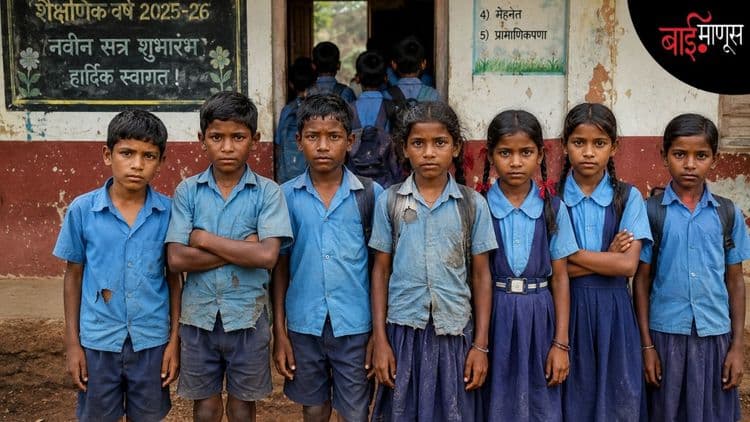
Even among the tribal people, the most deprived people opt for ashram schools. The overall condition of ashram schools, poor management, poor food, child mortality rate, death rate due to torture and snakebite, all the gross affairs came to the fore, and 'Shikshan Chaksh' was established. But the education room has not made the desired difference, and management is still poor. The condition of the ashram school building, school furniture, education, toilets are still poor. Teacher shortage is a big issue. So it is necessary for Ashram schools to have their own seat 'code book'.
Looking at the overall education and health situation in the country, there are still not enough facilities. The problems of tribal groups in Maharashtra are many. There is no change in their education, health and living conditions. This is the true reality.