Sakshi Tangde
- This article explores how ‘Female Genital Mutilation (FGM)’ affects millions of Girls/Women globally. It begins with a real life story of two 11 year old girls ‘Mekiya’ and Magfira from Ethiopia and how they prevented themselves from being cut.
- It speaks of widespread practice globally. From its extreme intense presence in African Countries to its less known and undocumented presence in India.
- It also studies about the legal and human rights angle surrounding FGM, the role of organisations like UNICEF and UNFPA. and local networks trying to extinguish this practice.
- It explains the medical, social, and psychological consequences of FGM.
A Friend Who Spoke Up and Stopped the Blade
“My mom told me that I am going to be cut tonight. I am so worried.” Eleven year old Mekiya Mude whispered these words to her best friend while walking to the school in Ethiopia. Preparations had already begun at home for the “Ritual”. Mekiya had seen other girls return from the procedure in extreme pain, unable to walk properly, and she knew what was going to be served before her. her Friend Magfira was shocked and frightened, but she chose to speak up. She informed her father who was a member of the village surveillance team who used to work to stop such practices which made an urgent intervention in that process with the help of local authorities and cutting was stopped before it happened. Also, Mekiya was temporarily taken into protection.
Mekiya would later call her friend her ‘awule’ which means her ‘rescuer’. In many countries globally, stories like Mekiya’s are not rare. Her story is not just about friendship. It is about how deeply embedded practices like FGM continue to shape the lives of girls and how collective action can interrupt them.
Understanding Female Genital Mutilation and Its Global Reach
Female Genital Mutilation refers to procedures involving the total or partial removal of external female genitalia and that too for non medical reasons. Even though, It is internationally recognized as a violation of human rights, more than 230 million girls and women alive today have undergone FGM globally according to the data of UNICEF. Although the practice is carried out for non-medical reasons, the health professionals do this work In some countries like Egypt. However, it is also known as a form of gender-based violence.
In countries like Somalia, its frequency reaches upto 98%, being the highest in the world followed by Guinea, Djibouti, Egypt, Eritrea, and Sierra Leone, ranging near or above 90%. Across all countries where FGM is practiced combined, around 4 million girls globally each year are still at risk of being cut. This number comes from UNICEF and UNFPA global projections.
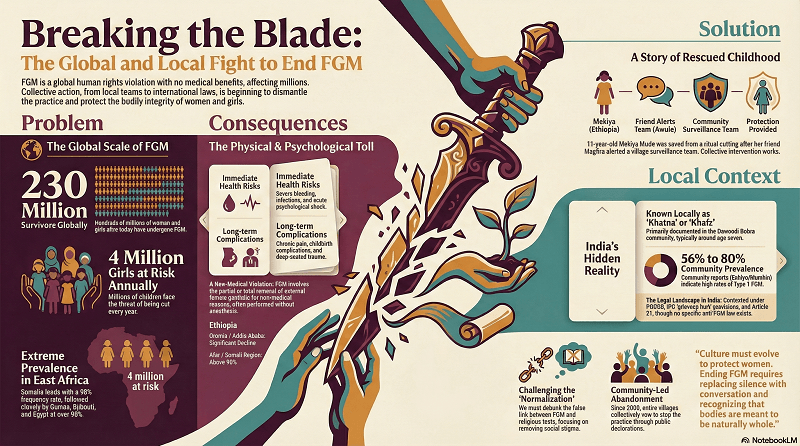 Inforgraphics (Image Credit: AI Generated)
Regions such as Oromia and Addis Ababa in Ethiopia have shown some significant declines in FGM since the 1990s. However, areas like Afar and the Somali region continue to report rates above 90%, highlighting how uneven and fragile progress of decline remains. The age at which girls are cut varies. In many communities, it happens before age five. Whereas, sometimes it is tied to puberty rituals, marriage preparation, or family ceremonies. There are also places where this practice occurs after childbirth.
Pain, Control, and the Normalization of Harm
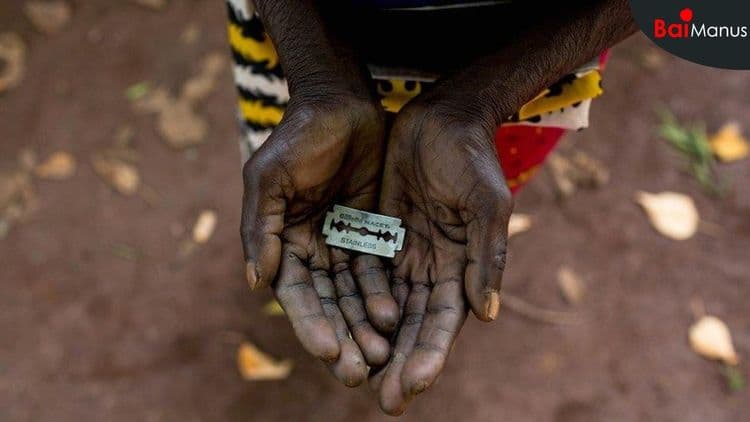
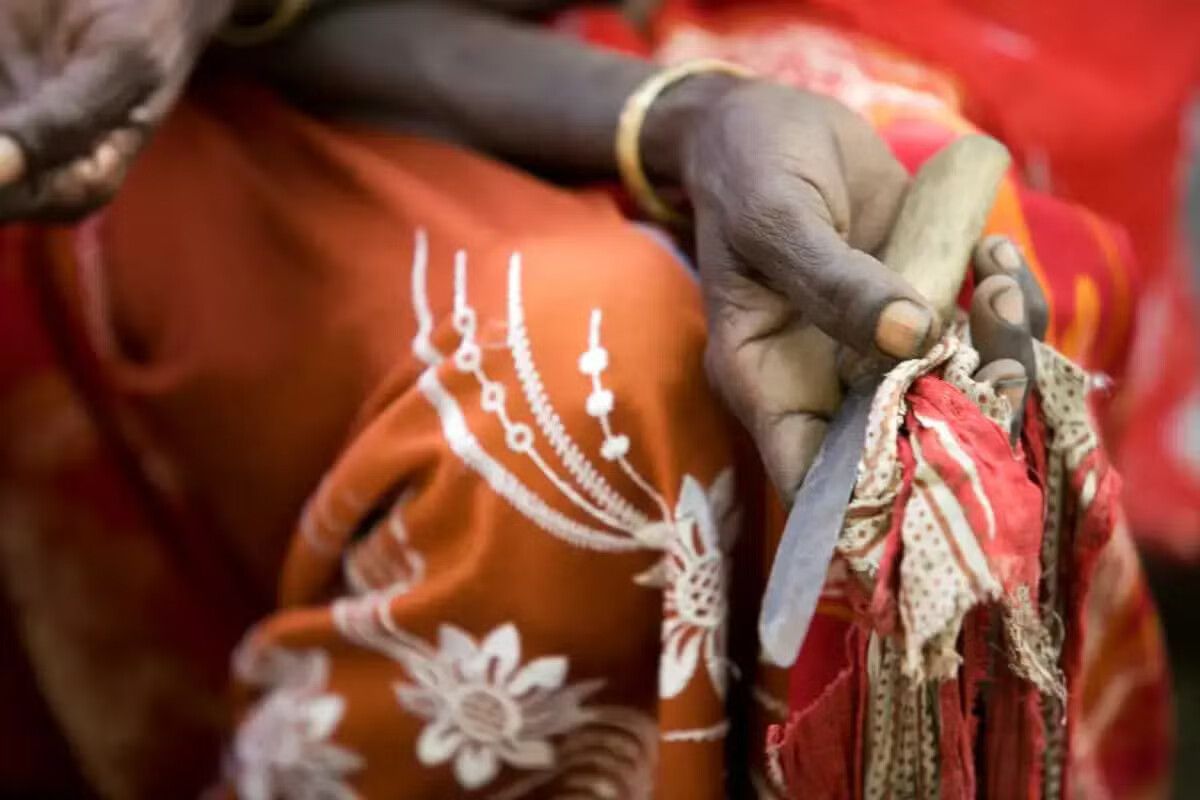
FGM is often performed without anaesthesia and under unsterile conditions, using blades or knives. No hygiene standards and no empathy has been seen in such practices. This risks immediate severe bleeding, infection, and major psychological shock. Long-term consequences range from chronic pain and childbirth complications to life long psychological trauma.
Yet within practicing communities, the act is often normalized. Families describe it as a minor cut or connect it to religious norms. However, none of the religious texts has mention of such a cutting ritual. It’s the Social acceptance which has become the driving force. Parents fear that uncut daughters may face stigma, rejection, or reduce marriage possibility.
This normalization is perhaps the most troubling tangent.
India’s Quiet Reality
We have been talking about African countries but let’s now acknowledge how India stands in this practice. Unlike many nations, India has no National Survey Data on FGM. However, least we know is that the practice is not as widespread across the country as African regions. Community-based study ’Sahiyo Report (2017)’, survivor testimonies (WeSpeakOut / Mumkin Campaign), and ongoing Supreme Court proceedings (Sunita Tiwari vs Union of India (Supreme Court PIL, 2017–ongoing) indicate that FGM, locally referred to as ‘khatna’ or ‘khafz’. It is practiced among sections of the ‘Dawoodi Bohra’ community in India.Typically performed around the age of seven, the procedure generally involves Type 1 FGM which means removal of the clitoral hood. The prevalence rate is between 56-80% within that community, though no official government figure exists. However, the lack of systematic data collection keeps the documentation shaded.
Law and Human Rights
As mentioned above, FGM is internationally recognized as against the bodily integrity and children’s rights. Whereas, In India, even without a specific anti FGM rule, the practice can fall under the ‘Protection of Children from Sexual Offences (POCSO) Act’, provisions of the Indian Penal Code related to grievous hurt, and constitutional protections under Article 21 guaranteeing the right to life and dignity.Globally, efforts led by UNICEF and UNFPA focus on community based abandonment strategies. Since 2008, their joint programme has helped multiple countries adopt anti-FGM legislation and facilitated public declarations of abandonment by millions of community members.
Ending the Practice
The lesson from Mekiya’s story is clear : change happens when one stands for another, when communities decide collectively that tradition cannot justify harm! Surveillance teams, religious leaders, women’s groups, educators, and activists play critical roles in shifting attitudes.Ending FGM requires more than laws. It requires talking about the deeply held beliefs about purity, honor, and control over female bodies. and the acceptance that the bodies are made how they are meant to be naturally. It requires replacing silence with conversation, and fear with protection.Every statistic represents a child who did not choose. Every intervention represents a possibility that she might.And as long as millions remain at risk, the question is not whether the practice is cultural, but whether culture can evolve fast enough to protect its Women.